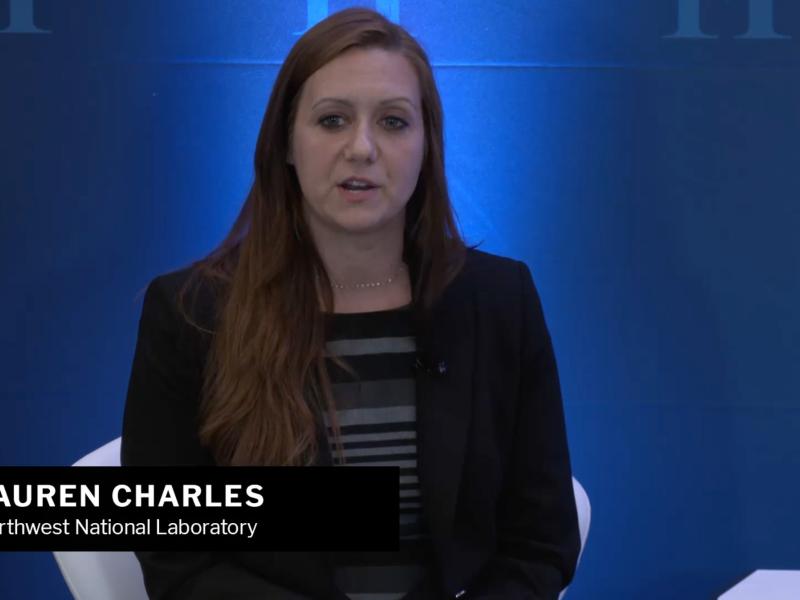
Lauren Charles, a chief data scientist at PNNL, will be presenting at the Forum on Microbial Threats for the National Academies of Sciences, Engineering, and Medicine.
Despite the widespread presence of RNA viruses in soils, little is known about the relative contributions and interactions of biological and environmental factors shaping the composition of soil RNA viral communities.
PNNL staff in the Artificial Intelligence and Data Analytics division were recognized by the TSA’s Innovation Task Force (ITF) for their contributions to cloud capabilities, development strategies, and smart management of cloud resources.
Researchers found that in a future where the Great Plains are 4 to 6 degrees Celsius (°C) warmer as projected in a high-emission scenario, these storms could bring three times more intense rainfall.
At the National Homeland Security Conference, researchers shared how partnerships and emerging technologies like artificial intelligence can play a key role in emergency management preparedness and response.
Erich Hsieh, Deputy Assistant Secretary for OE’s Energy Storage Division, shared insights about the Grid Storage Launchpad and energy storage innovations .
A multi-institutional team of researchers conducted a 13C-labeling greenhouse study using a semi-arid grassland soil, where they tracked the fate of 13C-labeled inputs from living roots and decaying roots from annual grass Avena barbata.
In the latest issue of the Domestic Preparedness Journal, Ashley Bradley and Kristin Omberg share how new research is shedding light on the scientific and technological challenges with detecting fentanyl.
Kriston Brooks received the 2023 Department of Energy Office of Classification Outstanding DC Award, which is given to those in the classification community who have made significant contributions.