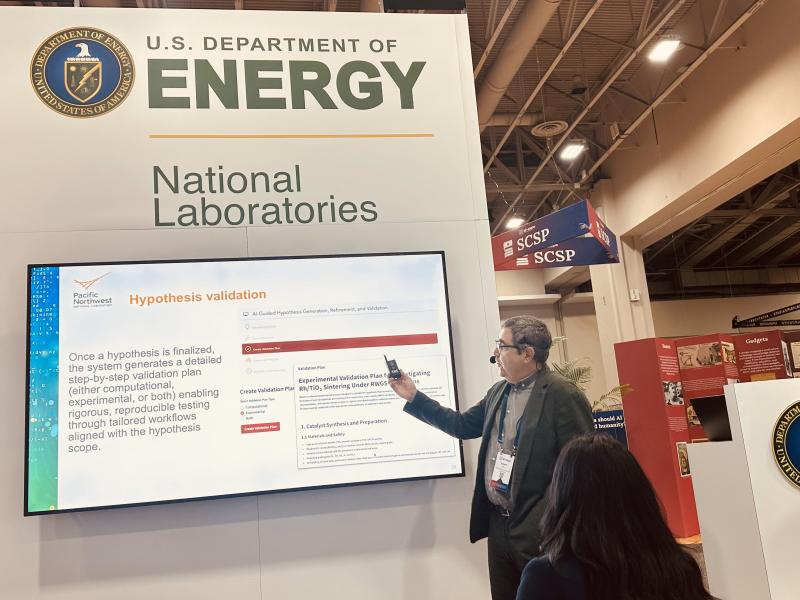
PNNL’s year in review includes highlights ranging from advancing soil science to understanding Earth systems, expanding electricity transmission, detecting fentanyl, and applying artificial intelligence to aid scientific discovery.
This project sought to assure that research activities centered around different sampling and monitoring efforts in northwest Ohio would not disturb any historical cultural resources.
A team of researchers recently coordinated a series of international workshops aimed at enhancing chemical research security and fostering collaboration among scientists and academic researchers from both countries.
PNNL Earth scientist Alison Delgado will serve as an author for the “Science of Response Management” chapter of the Sixth National Climate Assessment (NCA6.)
In partnership with the Ukrainian Government, PNNL and other U.S. implementers set out on a journey to create a roadmap to rebuild, modernize, and decarbonize Ukraine’s steel industry with small modular reactors.
PNNL researchers Marisa Decillis and Luke Richards contributed to a Center for Security and Emerging Technology report, “Securing Critical Infrastructure in the Age of AI.”