July 23, 2026
Feature

The Electricity Infrastructure Operations Center Marks 20 Years of Advancing Grid Innovation

From smart grid pioneers to AI innovators, the EIOC continues shaping the future of the power grid

Two people stand over a desk looking at a laptop. Beyond them is a large screen covered in grid modeling data.

When Pacific Northwest National Laboratory (PNNL) launched the Electricity Infrastructure Operations Center (EIOC) two decades ago, the world looked very different from the one the grid must support today. The first smartphones and smart devices were coming out. Electric vehicles were still niche. Cloud computing was in its infancy, and data centers had not yet grown into the massive, energy-intensive campuses that now anchor the digital economy. Yet even then, the technologies that would soon reshape daily life were starting to place new demands on a power grid never designed for such complexity.

The problem was there was no national facility capable of testing these new grid technologies and providing realworld training for system operators.

Recognizing this gap early, grid modernization leaders at PNNL envisioned a dedicated space for understanding—and preparing for—the grid of the future, guided by what they often called “following the path of the electron.” 

Out of that vision came the EIOC.

This year, PNNL is celebrating the 20th anniversary of this first-of-its-kind facility. Funded by the Department of Energy’s Office of Electricity, supported by PNNL investments, and strengthened through industry partnerships, the EIOC is a space dedicated to developing, testing, and demonstrating technologies that make the grid more resilient, reliable, affordable, and secure.

Eric Andersen, director of the EIOC and senior project manager at PNNL, sees the EIOC as essential to bridging research and practice. 

“Utilities need a place to experiment safely and see how new technologies behave in real conditions,” said Andersen. “The EIOC provides a sandbox and a launchpad for innovation that ensures solutions are technically sound and operationally realistic.”

PNNL is celebrating this important anniversary with technology showcase webinars highlighting new research and development happening in the EIOC. You can sign up for the mailing list to receive notifications of future webinars and events.

20 years of following the path of the electron

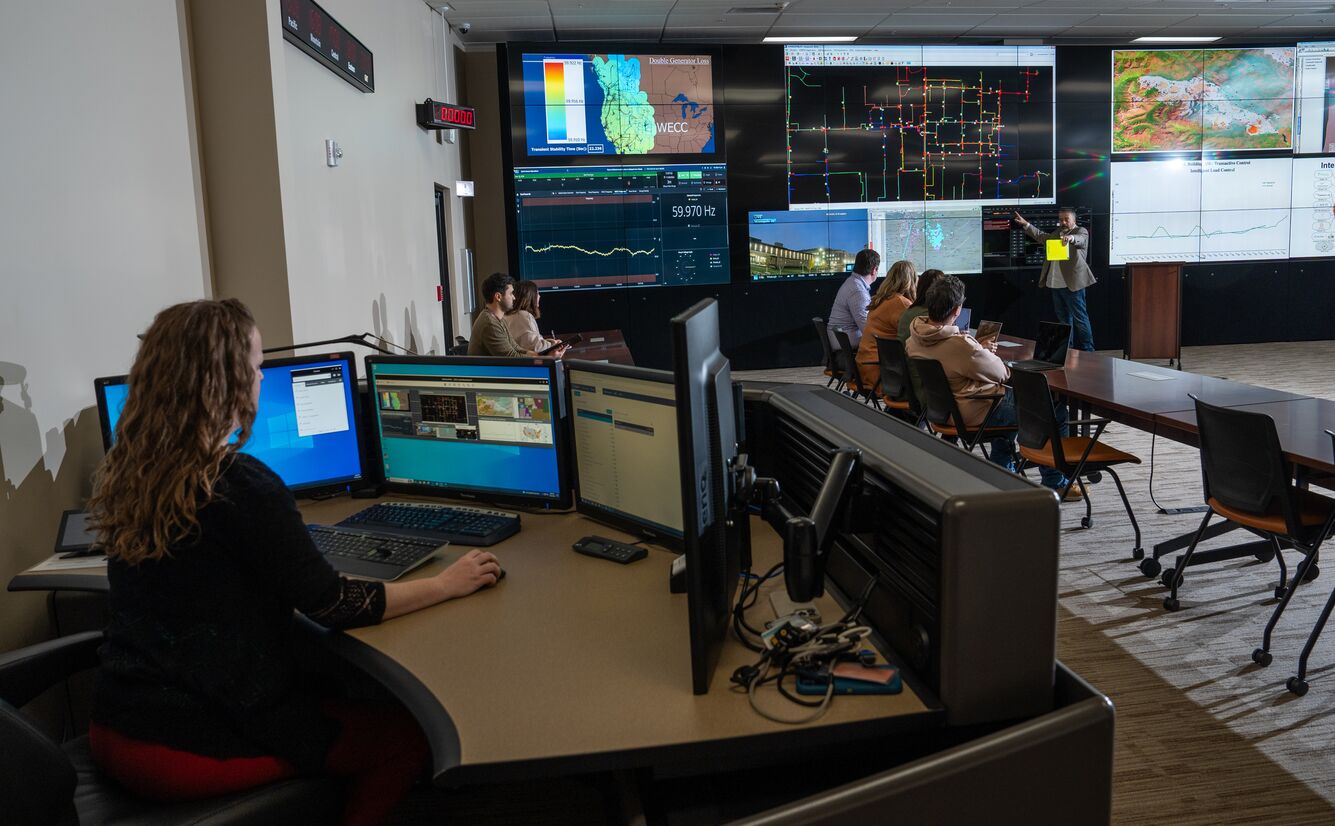
The EIOC first took shape in a single room inside the original MATH building on Battelle Boulevard on the PNNL-Richland campus. As its mission and capabilities grew, the EIOC expanded into the 3820 Systems Engineering Building, where it now features two fully functional, configurable control rooms designed to support operator training and enable complex simulations.

The EIOC also comes equipped with industry-leading power systems engineering software, offering tools for modeling, real-time simulation, optimization, and advanced analysis.

Photograph shows people sitting in a conference room looking at various screens, large and small.
The EIOC is now located in the Systems Engineering Building and features two fully functional and configurable independent control room environments linked with a dedicated network and server enclave. (Photograph by Andrea Starr | Pacific Northwest National Laboratory)

None of that would do much good without data—luckily, the EIOC has plenty, both real and synthetic.

In the EIOC, researchers and trainers have a place to develop and demonstrate advanced technologies and deliver training in a realistic operational setting without putting the actual grid at risk.

Just ask Michael Cassiodoro with Total Reliability Solutions. For the past 10 years, Cassiodoro has partnered with PNNL to deliver training for power system operators and operations support staff.

“At the EIOC we’ve had access to cutting edge technologies that are not readily available to the public and allowed us to leverage the Lab’s state-of-the-art facilities to provide highly valuable training opportunities that prepare electric industry staff to operate the grid of the future,” said Cassiodoro. 

These trainings also give us a unique opportunity to study how real operators think and perform in complex, highconsequence situations.

“The EIOC offers a highfidelity environment that captures the nuance and dynamic nature of actual control rooms. Because it attracts experienced operators, the insights we gather here translate much more directly to realworld grid operations,” said Corey Fallon, human factors researcher at PNNL.

20 years of evolving with the grid

Twenty years ago, the grid operated with limited telemetry, and operators could only see a small slice of what was happening. With major Department of Energy investments, phasor measurement units were deployed nationwide, giving us real‑time insight across the system. That foundation led to advanced control room tools—like oscillation detection—that transformed wide‑area situational awareness.

Early research in the EIOC focused on transactive energy and the smart grid. Now, researchers at PNNL are exploring AI-enabled decision support and deploying AI to study how to secure the future electric grid

Technologies like the synchrophasors for grid oscillation detection, the Dynamic Contingency Analysis Tool, and the Electrical Grid Resilience and Assessment System have all emerged from the EIOC.

The EIOC’s impact goes far beyond research alone. 

Over the years, it has hosted training programs for grid operators, workshops for state legislators and public utility commissioners, and sessions with industry leaders seeking to understand emerging grid technologies.

Today, the EIOC continues to adapt as the grid faces new pressures from AI and large electric loads such as data centers, along with persistent challenges from distributed energy resources, extreme weather, and growing cybersecurity risks.

The EIOC is responding by partnering with other national laboratories to build a federated testbed that will help industry explore and validate technologies for the control room of the future. Over the past year, this multilab team has gathered input from a wide range of stakeholders to define what a national testbed needs to support better realtime operations and integrate AI.

“The grid has changed faster in the past 20 years than in the previous hundred,” said Kevin Schneider, Laboratory Fellow at PNNL. “What makes the EIOC special is that it never stands still. We’re already preparing for what comes next.”

Working in collaboration with the Office of Electricity, PNNL and the EIOC will continue to support activities that stabilize, optimize, and grow the nation’s critical electrical infrastructure for years to come.

###

About PNNL

Pacific Northwest National Laboratory draws on its distinguishing strengths in chemistry, Earth sciences, biology and data science to advance scientific knowledge and address challenges in energy resiliency and national security. Founded in 1965, PNNL is operated by Battelle and supported by the Office of Science of the U.S. Department of Energy. The Office of Science is the single largest supporter of basic research in the physical sciences in the United States and is working to address some of the most pressing challenges of our time. For more information, visit the DOE Office of Science website. For more information on PNNL, visit PNNL's News Center. Follow us on Twitter, Facebook, LinkedIn and Instagram.