Critical Materials Separations Laboratory
United States

The autonomous laboratory for critical materials separations in the Energy Sciences Center is a space that brings together automated instruments with agentic workflows to enable discovery and advancement in separations science and technology. The platform leverages high-throughput robotics for chemistry experiments and an array of instruments for sample processing, multimodal spectroscopy characterization, and mass spectrometry for the automated evaluation of product purity and yield. The laboratory hardware couples to agentic AI workflows for feedstock evaluation, hypothesis generation, data acquisition, and processing to recover critical materials using multiple techniques, including selective precipitation, electrochemical, magnet-based, and biomolecular approaches.
The lab runs on the CICERO (Computer Intelligence for Critical Element Recovery and Optimization) workflow and leverages SciLink, a PNNL-developed interface and set of agentic tools for scientific planning and analysis. Through CICERO, the team can rapidly analyze and plan experiments to separate new feedstocks and refine separations via natural language interactions. Using their agentic tools, the team can plan novel experiments, draft automated robotic protocols, and run machine learning algorithms to analyze collected data and optimize iterative experiments.
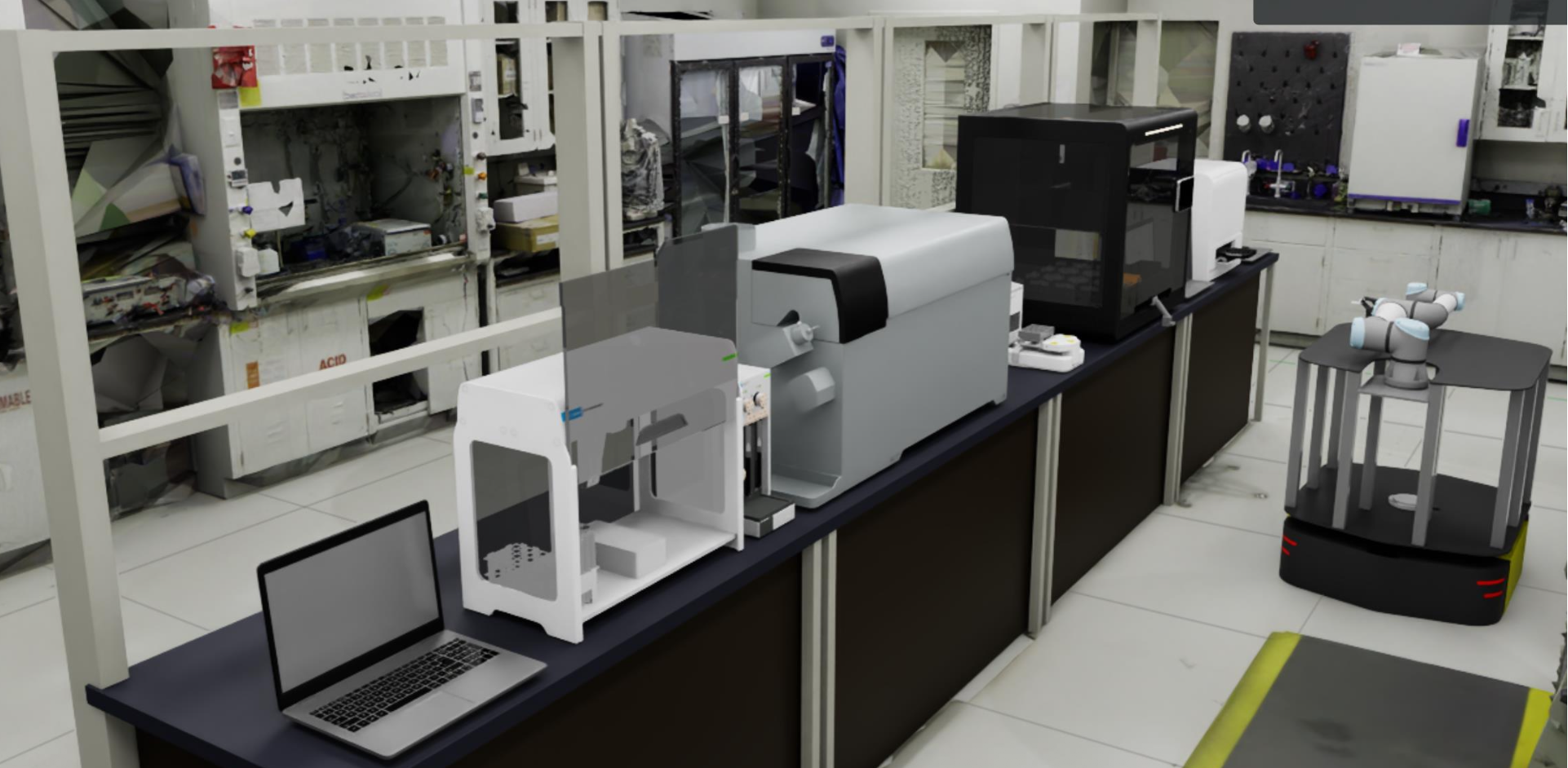
Key to the separations experiments is the Opentrons Flex, an Opentrons robotic platform system. It can measure and mix reagents and samples with microliter precision on the 200–2000 µL scale per experiment, in single or 8× pipetting modes. The system accommodates reaction grids of 96 parallel experiments for experimentation and exploration. The Opentrons runs on easily human-readable and modifiable Python code that can be generated and reviewed through SciLink.
- Single and 8× channel pipettes
- 2× heater/shaker modules that can heat up to 95 °C
- Gripper for sample transport and custom tooling
- Magnetic staging plate for magnetic experiments
- 12 deck slots
The Opentrons workflow can be coupled with additional instruments to access more types of data including plate-based ultraviolet–visible light spectroscopy, centrifugation, and inductively coupled plasma–mass spectroscopy for elemental analysis. These data can be fed back into SciLink for iterative experimental planning.