Technology Overview
High-resolution spatial proteome mapping requires the ability to analyze thousands to tens of thousands of microscale tissue voxels (or pixels) by using mass spectrometry (MS)-based proteomics. Efficiently collecting these voxels remains a major challenge—this is a labor-intensive process, and it can take weeks to collect even a few hundred tissue voxels. Developing a standardized well plate could enable routine, robust, high-throughput, cost-effective voxel collection.
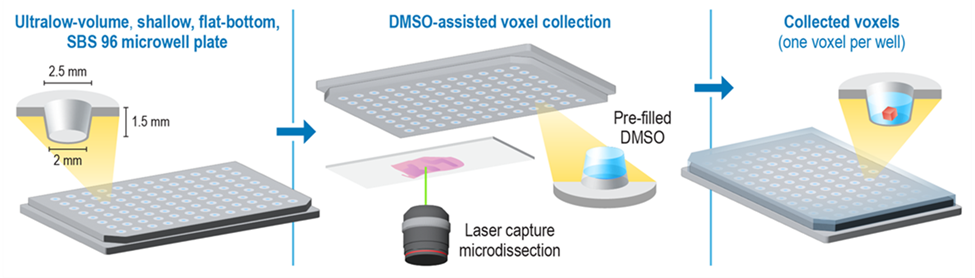
Researchers at Pacific Northwest National Laboratory designed, optimized, and refined a prototype for an ultralow-volume, shallow, microwell-based SBS (Society for Biomedical Sciences) 96-well plate. The plate is fully compatible with multiple laser capture microdissection (LCM) instruments, enabling automated, robust, rapid collection of thousands of single voxels within a short period. It has broad applications for the collection and processing of microscale voxels from various types of tissues before they are subjected to MS-based proteomics analysis.
The team generated substantial spatial proteome mapping data and is currently refining the ultralow-volume 96-well plate for massive production.
DESIGN
SBS multiwell plates are promising for scalable spatial proteome mapping for broad compatibility. Currently available standard SBS multiwell plates lack the precision and robustness required for spatial proteome mapping because of their deep well depth and large well volume, which result in ineffective voxel collection (and processing) and difficult voxel inspection. To address these issues, researchers designed an ultralow-volume, shallow, microwell-based SBS 96-well plate. The first prototype ultralow-volume 96-well plate was generated through 3D printing with polystyrene material, which provided low cost and a short turnaround time. Its performance was systematically evaluated, with a focus on the robustness and throughput of collecting hundreds of single voxels of different sizes, ranging from 20 µm × 20 µm (~1 cell region) to 200 µm × 200 µm (~100 cell region). After seven rounds of iterative optimization and refinement, the final prototype plate (seventh prototype plate) has a “conical cylinder” shape and flat-bottom wells with a top-well diameter of ~2.5 mm, bottom-well diameter of ~2 mm, and depth of ~1.5 mm. With a demonstrated 100 percent success rate in voxel collection and tight sealing for each well during voxel processing, the final prototype was used as the mold for injection molding. A polypropylene material was selected to generate the ultralow-volume, shallow, microwell SBS 96-well plate because it is resistant to organic solvents, has low binding to proteins and peptides, and is tolerant to a wide range of temperatures, from −80°C to 120°C. Moreover, the preloaded nonvolatile dimethyl sulfoxide (DMSO) in each well maintains the plate well volume during the voxel collection period, ensuring a 100 percent success rate in voxel collection. Compared with this ultralow-volume 96-well plate, no other technologies or methods are anywhere near as effective for high-throughput voxel collection and processing in high spatial resolution proteome mapping of tissues.
Advantages
- The ultralow-volume, shallow, SBS 96-well plate is scalable and fully compatible with commercially available LCM instruments, plate sealing films, heating devices, and liquid handlers and enables easy inspection of collected single voxels in the well plate.
- This plate has successfully addressed the challenge in unbiased spatial proteomics of achieving robust high-throughput collection and processing of hundreds to thousands of tissue voxels at high spatial resolutions.
- It is the only technology that can be used for large-scale spatial proteome mapping of tissues.
- It has broad applications to different types of tissues (fresh frozen, optimal cutting temperature–embedded, and formalin-fixed, paraffin-embedded).
- The ultralow-volume, shallow SBS 96-well plate will be commercially available in a cost-effective manner.
For more information, please contact: commercialization@pnnl.gov.
State of Development
Patent(s) pending