Technology Overview
Thanks in large part to recycling, three-quarters of all aluminum ever produced is still in use today. But while aluminum recycling is effective and cost-efficient for some uses (like soda cans), it historically hasn’t been viable for use cases with higher product performance standards.
Pacific Northwest National Laboratory (PNNL) has developed a new technology that enables quick and easy optical sorting of aluminum scrap, addressing a major barrier to wider reuse of aluminum scrap in applications like automotive manufacturing.
In shredded post-consumer aluminum scrap, both cast and wrought aluminum parts—which contain different amounts of silicon and alloying elements—are mixed together. That medley of cast and wrought aluminum needs to be heavily supplemented with new (“primary”) aluminum for use in higher-value added automotive manufacturing, construction, electrical, and aerospace applications.
Sorting the shredded scrap is easier said than done: most sorting methods suffer from prohibitive disadvantages in cost, throughput, or functionality when it comes to sorting aluminum scrap. As a result, most shredded aluminum scrap is exported and used for low-value cast products, such as toys and other inexpensive consumer items.
Optical sorting uses cameras and sensors to classify materials, then uses pressurized air to push them into sorted streams. It’s inexpensive and high throughput, but it historically hasn’t worked for sorting aluminum scrap because wrought and cast aluminum all appear the same to these sensors...
But what if there was a way to sort based on color differences due to variations in their alloy chemistry?
PNNL’s new process first immerses the aluminum scrap in an etching solution that leaves a dark brown or black residue only on cast aluminum pieces, allowing them to be separated from the wrought pieces. The wrought pieces are then immersed in another etching solution, which further changes the color appearance based on chemical make-up, which then can be sorted into alloy families (like Al 5xxx and 6xxx) by turning them gold, purple, green, and more.
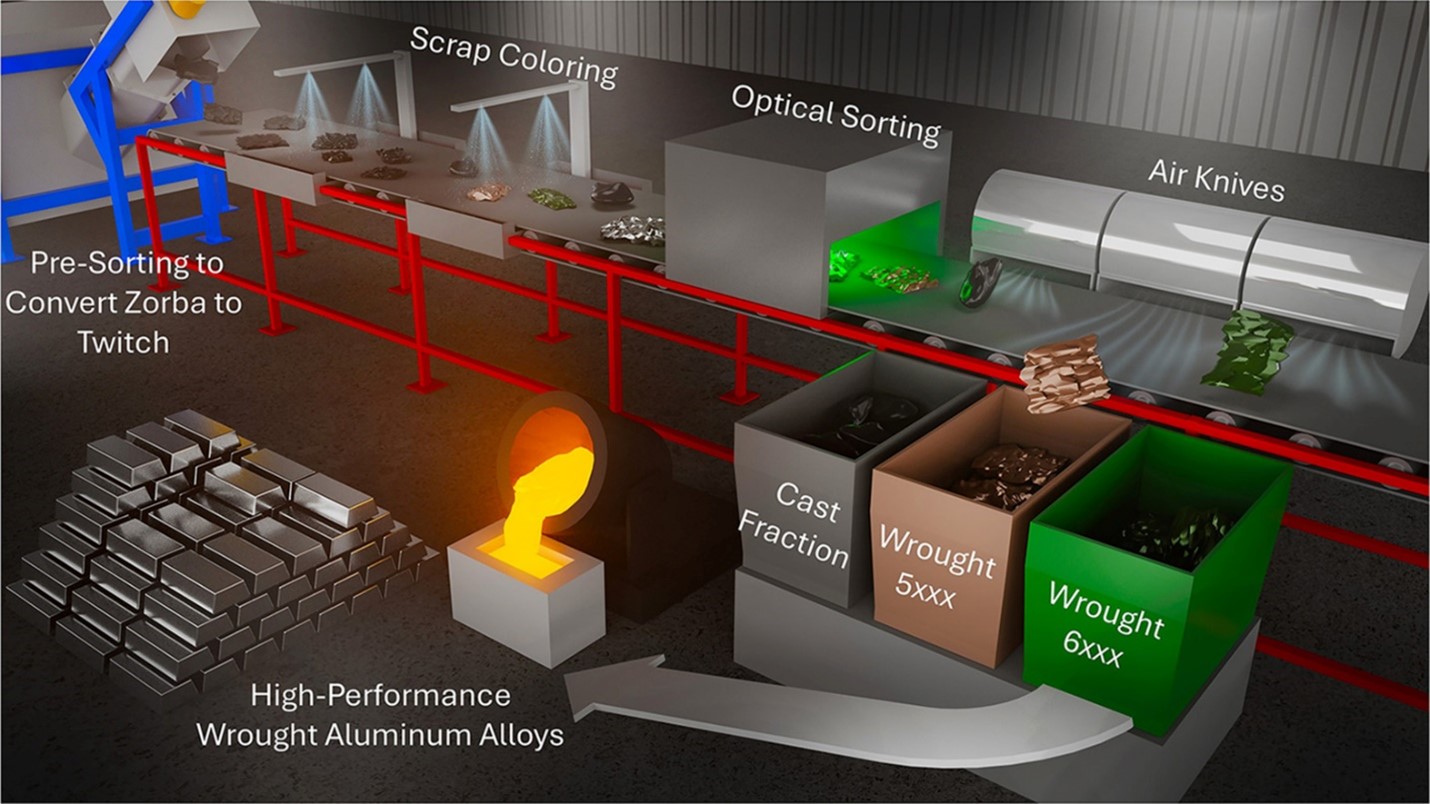
This color-coding allows the previously monochromatic aluminum scrap to be almost perfectly sorted by commercially available optical sorting systems: PNNL researchers have used this method to achieve >95% purity in the optically sorted cast and wrought scrap streams.
This straightforward approach is designed for compatibility with existing optical sorting technologies and opens the door for far wider reuse of vast aluminum waste streams for higher-performance products.
Advantages
- High-accuracy sorting of wrought and cast aluminum—as well as specific aluminum alloys (>95% purity in testing)—enabling expanded industrial use of aluminum scrap for high-performance applications
- Cost-effective approach that builds on widely tested, high-throughput optical sorting technologies
- Compatible with existing commercial optical sorting systems, diminishing need for new or costly equipment
- Reduced costs compared to alternative aluminum scrap sorting technologies.
State of Development
Available for licensing in all fields.