Technology Overview
Lead-212 (Pb-212) and bismuth-212 (Bi-212) are promising therapeutic radioisotopes for targeted alpha therapy. Pb-212 can be attached to tumor-targeting molecules, such as antibodies or other biological vectors, and transported to disease sites where it decays to Bi-212 and other short-lived daughters that deliver highly localized radiation. Because Pb-212 has a short half-life, practical deployment requires generator systems that can produce, recover, and prepare the isotope rapidly, reproducibly, and with minimal radiological dose to operators.
Researchers at Pacific Northwest National Laboratory have developed two related families of technologies for improved Pb-212/Bi-212 generation.
Technology 1: Automated preparation of traditional column-based Pb-212 generators
This family of inventions improves the preparation of conventional radium-224 (Ra-224)/Pb-212 generator columns. The technology uses remotely operated fluidic systems to isolate Ra-224 from the thorium-228 (Th-228) parent, remove Pb and Bi nuclides, recycle the Th-228, and deliver purified Ra-224 for loading onto a traditional cation-exchange generator column. The approach can reduce hands-on manipulation, eliminate cumbersome dry-down or acid-transposition steps, and enable automated or semiautomated preparation of medical isotope generator columns in shielded facilities.
The intellectual property family also includes additional inventions related to automated generator column assembly, source loading, storage or regeneration vessels, distributed resin-bed formats, and remote handling systems for preparing and packaging Ra-224/Pb-212 generators.
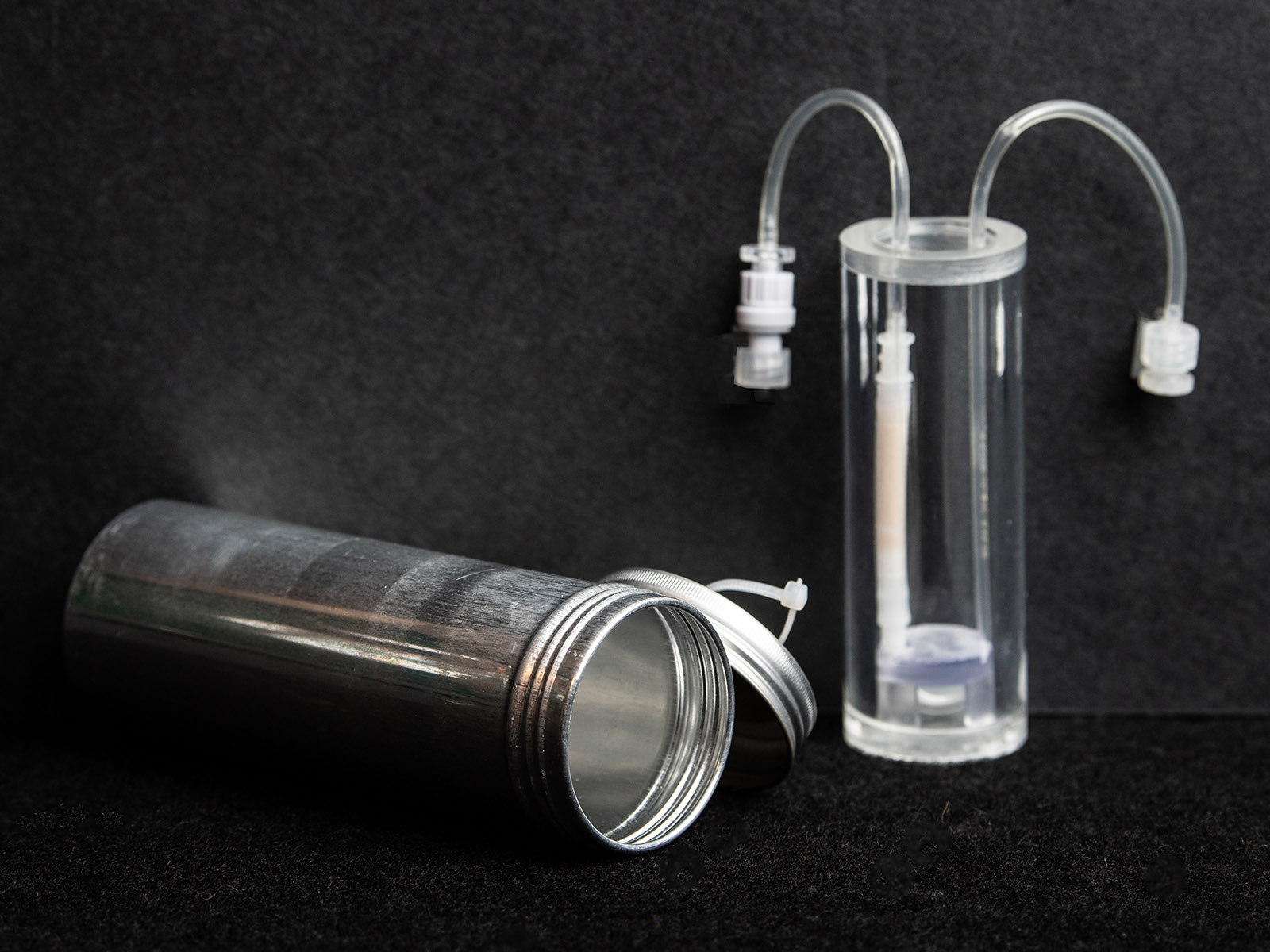
Technology 2: Gas-phase radon-220 (Rn-220) emanation generators for Pb-212 production
This separate intellectual property family of inventions uses a different generator architecture. Instead of relying on aqueous elution from a traditional parent-loaded column, Rn-220 is emanated from a Th-228- or Ra-224-bearing source and transported as a gas to a physically separate collection region. The collected Rn-220 then decays to produce high-purity Pb-212 and Bi-212, which can be recovered from the downstream collection device.
This platform separates the parent Ra-224 source from the product-collection region by exploiting the noble-gas intermediate Rn-220. The technology employs novel Rn-220 emanation-source media, materials, and surfaces for downstream Rn-220 and Pb-212 collection, and integrated automated devices that perform radon emanation, transport, decay/collection, and aqueous recovery of the in-grown Pb-212 product into a label-ready buffer solution.
Advantages
Technology 1: Traditional column-generator preparation
This approach enables the remote or automated preparation of conventional Pb-212 generator columns while reducing the manual handling of high-dose materials. The process separates Ra-224 from Th-228, Pb-212, Bi-212, and other progeny before generator loading, allowing the purified Ra-224 fraction to be handled in a lower-dose state during column preparation. The technology may support more reproducible generator production, improved operator safety, and streamlined preparation of medical-grade Pb-212/Bi-212 generators.
Technology 2: Gas-phase radon emanation and collection
The gas-phase approach physically separates the Ra-224 parent source from the downstream Pb-212 product-collection region. This can reduce the parent breakthrough concerns associated with liquid-phase generator columns and may simplify the recovery of high-purity Pb-212 by allowing the product to form in a separate collection device. In its simplest form, the system can use carrier-gas transport, surface-based radon capture, and aqueous recovery of the in-grown Pb-212 product.
General benefit
Both technology families are intended to improve access to Pb-212/Bi-212 by reducing labor, shortening preparation timelines, minimizing radiological dose to operators, and enabling operation in shielded or automated production environments. These capabilities are important because Pb-212 must be produced close to the time and location of use to support radiopharmaceutical manufacturing and distribution.