Technology Overview
To reduce traffic congestion and energy expenditures of regional transportation systems, the Autonomous Intelligent Assistant (AutonomIA) delivers a new AI-based traffic management system that leverages advanced sensing, adaptive signaling technologies, and connected automated vehicle technology.
Transportation of people and goods accounts for 28 percent of U.S. annual energy use, whereas Americans spend on average 99 hours per year in traffic congestion, reflecting a cost of nearly $88 billion due to tailbacks. Optimizing traffic systems to coordinate signal-phase timing will reduce vehicle wait times and travel delays, which are critical to reducing traffic congestion and productivity losses. Emerging vehicle fleets containing a mix of nonconnected and connected automated vehicles (CAVs) with varied levels of autonomy present an opportunity for improved traffic management; however, they cannot be efficiently leveraged with traditional static, rule-based traffic control plans. These legacy approaches do not provide efficient solutions to today’s dynamic transportation ecosystem and leave significant operational efficiency gaps. They use old demand models that are less accurate compared to today’s data-driven models, which are capable of ingesting in real-time current, dynamic mobility data and patterns as experienced on a city’s road network. As such, there is an urgent need to develop a capability to manage dynamic city-level transportation network operations that can utilize advanced sensing and increased CAV penetration to simultaneously satisfy congestion and energy expenditure goals.
The AutonomIA framework overcomes present traffic management system limitations by leveraging smart and connected technologies embedded within individual vehicles and traffic infrastructure within a unified learning, simulation, and control paradigm to reduce congestion and improve energy efficiency by at least 20 percent. The main innovative components are 1) real-time and context-aware transportation state estimation from fusing traffic data, simulations, and contextual mobility information, 2) differentiable predictive control to optimize transportation network operations for system level traffic flow, energy efficiency, and energy expenditure, and 3) multi-agent reinforcement learning to generate policies for on-the-fly optimized timings of intersection level traffic signals.
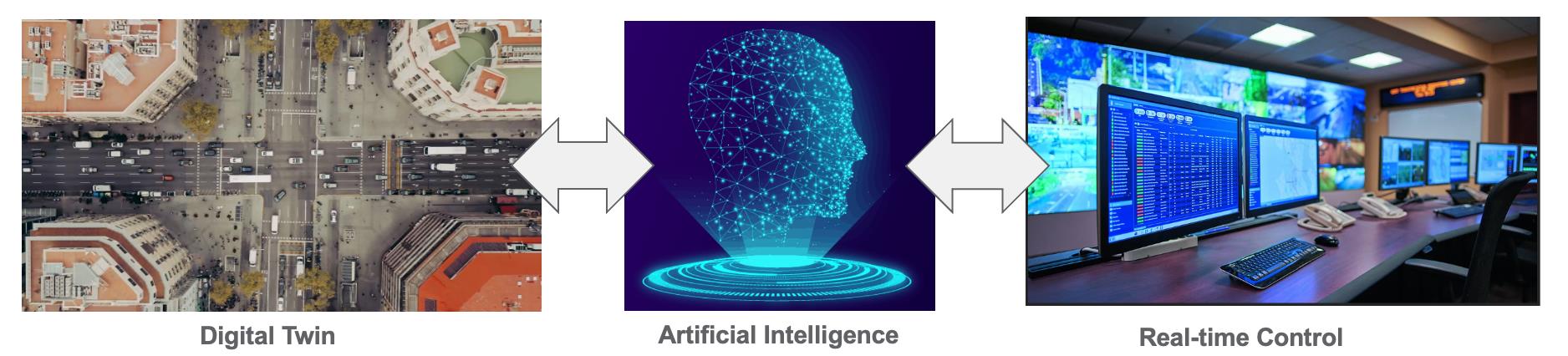
AutonomIA will reduce congestion and improve energy efficiency by minimizing travel delays and reducing idling times (i.e., waiting at intersections). To achieve real-world impact, the team includes relevant stakeholders from industry (Aimsun, Yunex Traffic, and Miovision) and the City of Coral Gables, Florida, serving as demonstration partner to pilot and assess effectiveness in multiple urban mobility scenarios.
1. Data-driven real-time traffic state estimation:
Traffic state estimation refers to determining traffic state variables (flow, density, average speed) on the entire road segments using only partial observed traffic data. To control and efficiently manage a traffic network, it is important to have access to the network state to make informed decisions. Hence, traffic state estimation is a key component of traffic control and operations, as traffic variables are not measured everywhere in the system because of technological and financial limitations and possibly noisy measurements.
In the AutonomIA project, we use traffic flow data from roadside units available at instrumented intersections and vehicle speed information from a limited number of CAVs to estimate in real time traffic states (traffic flow and average vehicle speed) across all road segments in the traffic network. Our approach is completely data-driven and is based on dynamic-mode decomposition (DMD) for system identification plus Kalman filtering. DMD is a dimensionality reduction algorithm that has become increasingly popular in studying fluid flows. It has been used to perform data-driven system identification, estimation, and control with applications in several areas. When given a time series of data, DMD computes a set of modes, each of which is associated with a fixed oscillation frequency and decay/growth rate. For linear systems in particular, these modes are approximations of the eigenvalues of the composition operator (also called the Koopman operator). Because these modes are not orthogonal (as in principal component analysis), DMD-based representations can be less parsimonious than those generated by principal component analysis and can also be more physically meaningful. As such, DMD can be used to extract low-order models from high-dimensional, complex systems. The method is data-driven in that it does not require knowledge of the underlying governing equation, only snapshots in time of measurements and actuation data from historical, experimental, or black-box simulations. After the linear system is identified using DMD, a Kalman filter is utilized to determine the system state (traffic flow or average speed) of the entire network based on a limited number of sensor measurements at instrumented intersections or basic safety message data from CAVs. A Kalman filter, also known as linear quadratic estimator, is an algorithm that uses a series of measurements collected over time and produces estimates of state space variables that minimize the mean square error of the estimated values.
2. Differentiable Predictive Control for Large-Scale Urban Road Networks:
AutonomIA leverages differentiable predictive control, a physics-informed machine learning methodology, to optimize traffic flow and minimize congestion in large-scale urban areas. The technology developed implements differentiable predictive control with the network macroscopic fundamental diagram (NMFD) models. This approach allows for high-level predictions of traffic patterns and effective control of traffic flows between city regions. The integration of NMFD into the Neural Modules with Adaptive Nonlinear Constraints and Efficient Regularizations (NeuroMANCER) program’s training structure enables various implementations to train the predictive control law and test it on known NMFD models. This learned control minimizes the vehicle accumulation in city regions over time, making traffic flow more efficiently and reducing congestion.
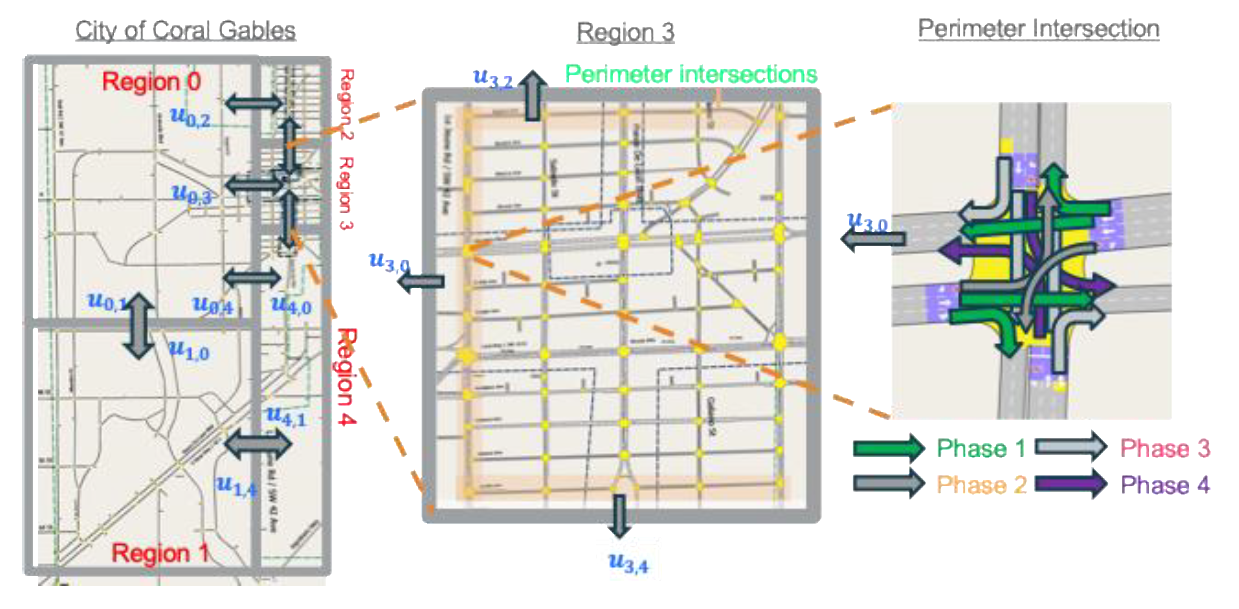
In empirical comparisons with existing state-of-the-art model predictive control methods, our approach demonstrates a four order of magnitude reduction in computation time and an up to 37 percent improvement in traffic performance. Furthermore, we have assessed the robustness of our controller to scenario shifts and find that it adapts well to changes in traffic patterns.
3. Multi-Agent Reinforcement Learning for Traffic Signal Control:
Traditional fixed-time traffic control relies on predetermined signal schedules that ignore real-time traffic demand, leaving them simple and predictable yet inefficient—especially with fluctuating demand. Actuated control improves upon this by using vehicle detectors to adjust signal timings based on actual traffic presence. Adaptive control represents the most advanced strategy, leveraging real-time, network-wide data to dynamically adjust signal phases, cycle orders, and durations. Although past research has advanced adaptive traffic control, significant challenges remain in optimizing signal-phase timing, coordinating across heterogeneous multi-intersection corridors, and validating performance under real-world traffic conditions.
The AutonomIA project developed a multi-agent reinforcement learning (MARL) traffic signal control approach and validated its performance within a novel hardware-in-the-loop (HiL) framework, using actuated control as the baseline for comparison.
The proposed framework integrates a real-world traffic controller with a digital twin calibrated with data from the City of Coral Gables, enabling real-time communication between simulation and traffic control infrastructure. The MARL algorithm runs on a roadside unit edge device and is implemented to update signal phases across several intersections. Both single- and dual-ring signal configurations are evaluated within the framework to reflect commonly deployed traffic configurations.

The HiL results show a 31 percent reduction in travel delay (sec/mi) in the morning and a 46 percent reduction in the afternoon, indicating significant improvements in traffic flow efficiency during peak periods compared to actuated control. This demonstrates the effectiveness of the MARL approach for adaptive traffic signal control through a HiL framework that integrates commercial traffic signal controllers, edge-computing roadside units, and a calibrated digital twin of a real-world traffic network. The framework uses standard National Transportation Communications for Intelligent Transportation System Protocol-based communication to ensure interoperability across heterogeneous infrastructure components. Experimental results demonstrate that MARL consistently outperforms conventional actuated control across all traffic demand scenarios.
Advantages
- Reduced congestion, enhanced traffic flow efficiency
- Improved energy efficiency
- Adaptable to various city traffic patterns and regional controls
- Integrates seamlessly with existing traffic management systems
For more information, please contact: commercialization@pnnl.gov