PNNL Training Advances Nuclear Power Plant Inspections in Armenia
Hands-on training builds local expertise in ultrasonic testing

Staff at Pacific Northwest National Laboratory and Armenian counterparts tour the Armenian Nuclear Power Plant during the June 2026 visit. The trip combined technical training with opportunities to learn more about plant operations and inspection needs.
(Photo: Armenian Nuclear Power Plant)
Researchers from Pacific Northwest National Laboratory (PNNL) recently led a workshop in Armenia to advance local expertise in nondestructive evaluation—a critical method for assessing the condition of nuclear power plant components.
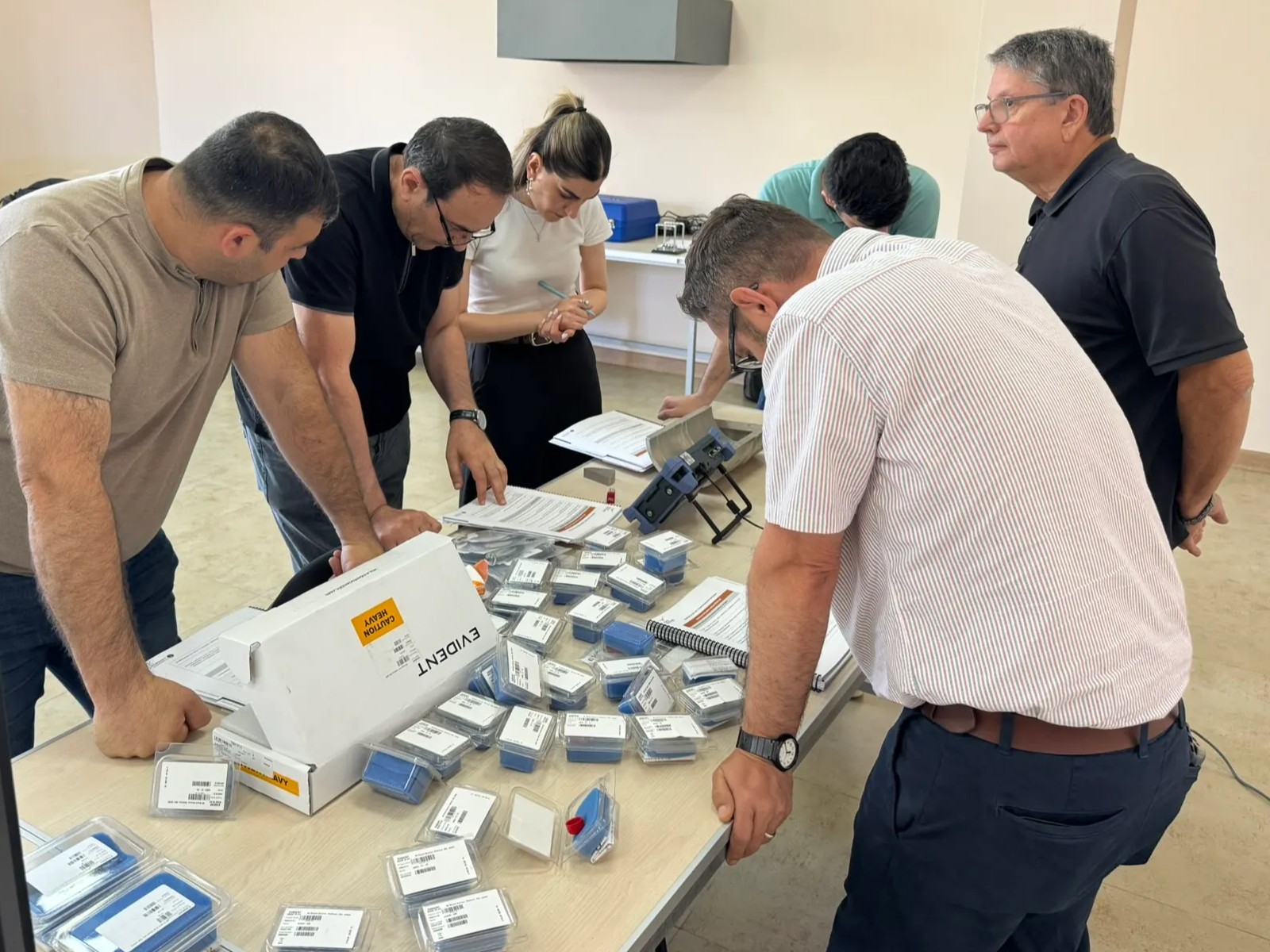
In June, research analyst Joel Harrison, physicist Richard Jacob, and nuclear engineer Don Todd traveled to Armenia to deliver training focused on ultrasonic testing (UT) at the Armenian Nuclear Power Plant (ANPP). The workshop integrated classroom instruction and expanded upon virtual training sessions presented by PNNL.
“An important component of the training includes hands-on practical exercises that allow the participants to become familiar with the ultrasound instruments and related equipment and apply their training to scenarios representative of examinations that would be experienced in a power plant,” said Harrison.
Developing expertise for nuclear inspections
UT employs high-frequency sound waves to examine nuclear reactor materials and components for subsurface flaws. Expertise in this technique enables organizations to conduct in-service inspections of nuclear power plant systems and to document inspection results effectively.
The collaboration between PNNL and the Armenian Scientific Research Institute for Nuclear Power Plant Operation (ARMATOM) aims to support the development of technology, resources, and personnel required to perform UT inspections at ANPP.
Foreign Affairs Specialist for International Cooperation Armando Crosland, from the Department of Energy’s Office of Nuclear Energy, has been involved with the project since Armenia first requested assistance. He highlighted PNNL’s expertise in nondestructive evaluation as vital to the project’s success.
“The experts from PNNL and their execution have been crucial to our progress,” Crosland said. “Their work supports the safe operation of Armenia’s current reactor, familiarizes the Armenian partners with U.S. standards and industry practices, and will support the future needs of their nuclear power program.”
Advancing toward independent certification
This training represents an initial step in a broader effort to enable ARMATOM to serve as a certifying body for nondestructive evaluation personnel supporting ANPP. PNNL is already planning for the next set of lessons: comprehensive testing of nuclear piping and components and support for the development of written procedures, quality assurance, examinations, training, and evaluation.

For future hands-on training, PNNL plans to incorporate specimens containing representative flaws, providing participants with opportunities to practice detecting conditions that may be encountered during inspections.
“It’s an honor to work with our Armenian colleagues to help them develop a plan for an independent and self-sustaining in-service inspection program. We love sharing our knowledge and expertise,” said Jacob, who is currently managing the project.
The nondestructive evaluation project with Armenia is led by the U.S. Department of Energy’s International Nuclear Energy Cooperation Program and received initial funding from the U.S. Department of State. PNNL’s engagement with Armenia in nuclear energy began in the 1990s, and the current initiative continues this long-standing technical partnership.
Published: September 1, 2026