September 3, 2026
Research Highlight

AI Powers Ability to Represent Microbial Processes in Ecosystem Models

Using an AI approach to combine outputs from microbial models and apply them as inputs to reactive-transport models reduces computational time by several orders of magnitude
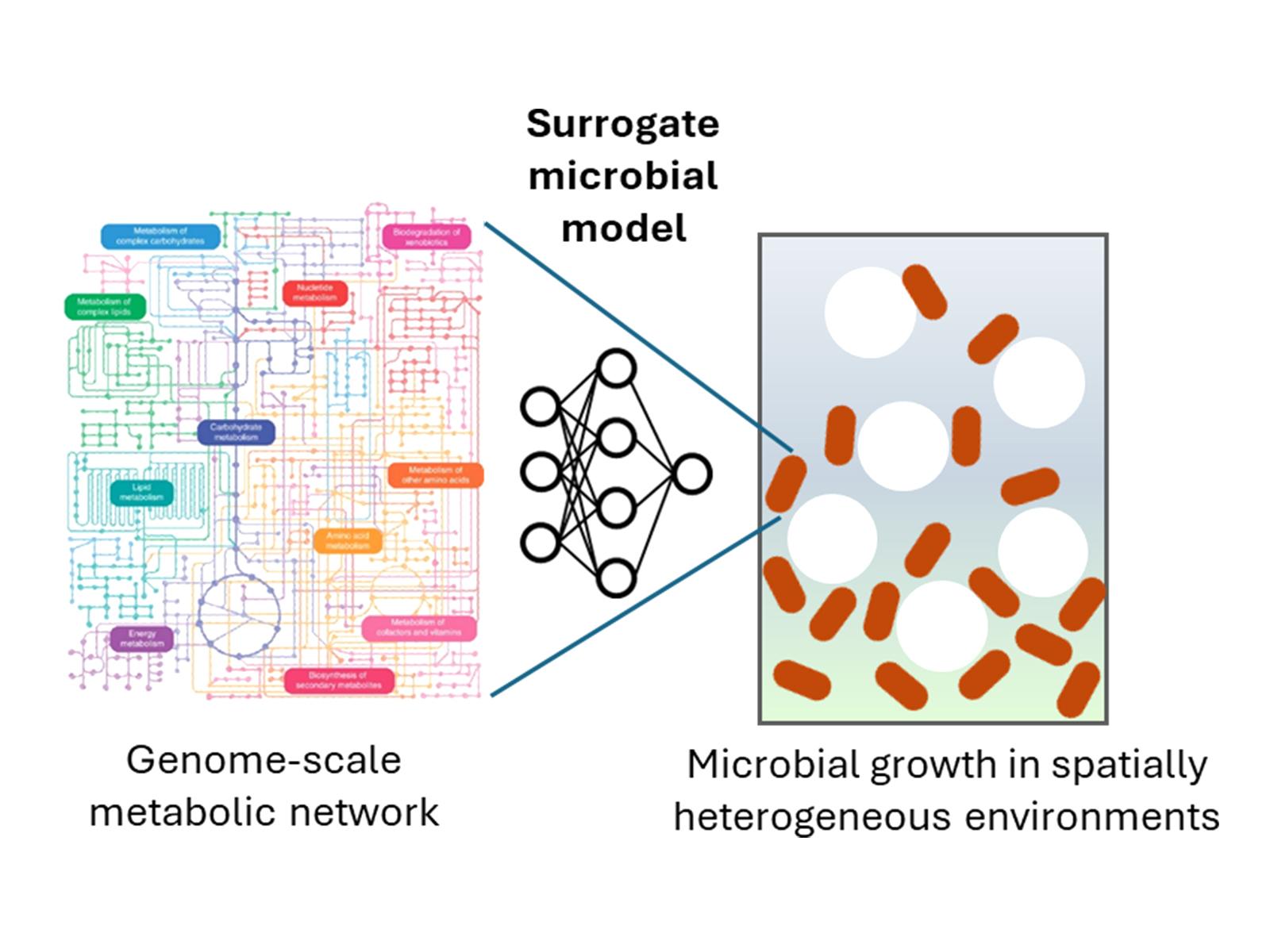
AI ecosystem model

Harnessing the power of artificial intelligence allowed for the seamless integration of metabolic networks of microbial communities with reactive-transport models. These integrated models describe important biological and physical processes that occur across scales. Pretrained artificial neural networks serve as surrogate microbial models for direct incorporation into reactive-transport models. 

(Figure: Hyun-Seob Song | University of Nebraska–Lincoln)

The Science

Studying how bacteria grow and metabolize different substances across space and time is essential for addressing a wide variety of challenges associated with understanding how the living Earth functions. However, modeling the dynamics of microbial processes at a high resolution is both complex and computationally demanding. A multi-institutional team of scientists introduced a novel modeling approach that employs artificial neural networks (ANNs) to create a surrogate model of genome-scale metabolic networks to efficiently simulate spatiotemporal dynamics in microbial metabolism. The ANNs were applied to Shewanella oneidensis, a microbe chosen for its complex growth patterns in response to different nutrients as well as its significant capacity to contribute to recovery of critical minerals and contaminant removal. Without compromising accuracy, the pretrained ANNs captured complex metabolic switches and could predict how S. oneidensis uses, produces, and transitions between nutrients. This method also demonstrated reduced computational time and enhanced numerical stability compared with other methods. 

The Impact

The successful use of an AI approach that employs ANNs, accelerates the simulation of complex microbial activities, and allows the direct integration of network models of microbial metabolic output dynamics into reactive-transport models (RTMs). This multi-institutional study is the first to successfully harness AI to integrate genome-scale metabolic networks with RTMs for faster and more stable simulations. As a result, new avenues for multiscale ecosystem studies are not only created, but understanding of microbial processes and interactions across diverse environmental settings can be greatly improved. This work also holds promise for other fields like critical mineral recovery, bioenergy research, and contaminant removal, where insights into microbial regulation and metabolism are crucial for developing bio-based solutions.

Summary

This multi-institutional study addressed the challenge of simulating the dynamical aspects of microbial metabolism accurately and efficiently in an ecosystem. A newly developed ANN-based approach predicted intricate metabolic switches in bacteria, enabled integration of outputs from these metabolic models into RTMs, and demonstrated significantly reduced computational time as well as improved stability compared with traditional models. By integrating ANNs into RTMs, researchers accurately simulated bacterial growth and nutrient utilization dynamics in both environmentally homogeneous and heterogeneous conditions. The results highlight the capability of AI to not only capture the complex behavior of microbes in dynamic environments, but to enable ecosystem-scale modeling that can offer insights into environmental, bioenergy, and bioeconomy applications. This advancement sets the stage for applying such methods to larger-scale ecosystem simulations, enhancing knowledge of microbial interactions across diverse scientific fields.

The initial draft of the text above was created using ChatGPT (version 5.5 or lower, OpenAI). The language and content were subsequently edited by the author for grammar, clarity, and accuracy, and the final document was reviewed by the author.

Research Contacts

Hyun-Seob Song, hsong5@unl.edu, University of Nebraska—Lincoln, corresponding author

Tim Scheibe, tim.scheibe@pnnl.gov, Pacific Northwest National Laboratory

James Stegen, james.stegen@pnnl.gov, Pacific Northwest National Laboratory

Funding

This research was supported by the U.S. Department of Energy, Office of Science, Biological and Environmental Research program, Environmental System Science program. This contribution originates from the River Corridor Science Focus Area project at Pacific Northwest National Laboratory and was supported by the partnership with the IDEAS-Watersheds project. Battelle Memorial Institute operates Pacific Northwest National Laboratory for the Department of Energy. Some support also came from the Genome Resolved Open Watersheds project, also supported by the Department of Energy, Office of Science, Biological and Environmental Research program.

Related Links

Published: September 3, 2026

Song, HS., Ahamed, F., Lee, JY. et al. Coupling flux balance analysis with reactive transport modeling through machine learning for rapid and stable simulation of microbial metabolic switching. Sci Rep 15, 6042 (2025). https://doi.org/10.1038/s41598-025-89997-9