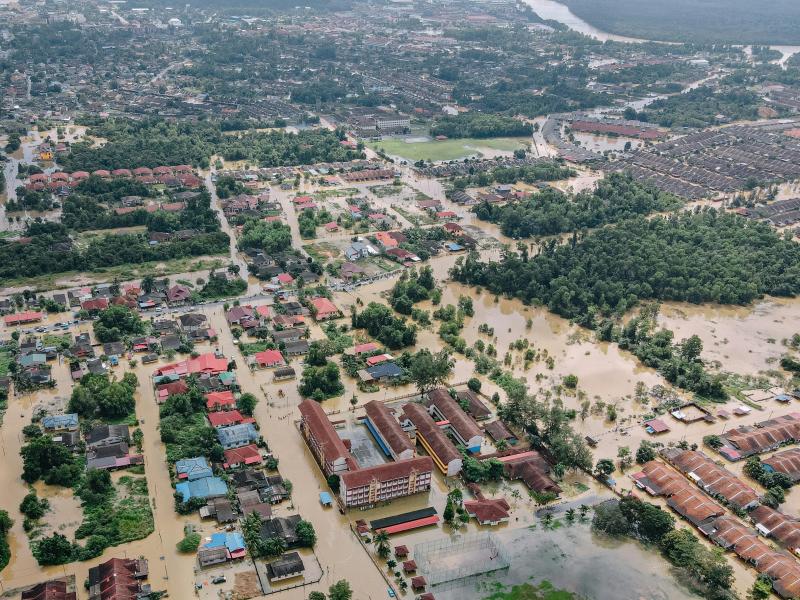
New datasets delineating global urban land support scientific research, application, and policy, but they can produce different results when applied to the same problem making it difficult for researchers to decide which to use.
A tethered balloon system was used at the Southern Great Plains atmospheric observatory in Oklahoma to collect atmospheric particles from ground and aloft levels. Samples were later analyzed for their organic molecular composition.
A multi-institutional team of researchers systematically compared extraction techniques for characterizing plant litter composition that relies on organic matter extraction.
A recent paper published in Science sheds light on how aerosols—tiny particles in the air—released by industrial activities can trigger downstream snowfall events.
The demand for energy is growing—and so is the technology supporting it. However, future development of power generation technologies could be affected by a key factor: material supply.
Alicia Amerson's passion for science communication, expertise in marine mammal research, and experience in wildlife photography provide a robust foundation for her new role with the Clallam County Marine Resources Committee.
Through a detailed examination of historical data supported by mechanistic analysis and model experiments, researchers unveil that a large-scale climate system intensifies heat extremes and wildfire risks in the PNW.
This study shows that dry dynamics alone is not enough to understand jet stream persistence. Instead, clouds and precipitation are more important contributors than internal “dry” mechanisms to this memory of the Southern Hemisphere jet.
The National Business Aviation Association has named Andre Watson, PNNL's director of Aviation Maintenance, to the 2024 class of the Business Aviation Top 40 Under 40.
This study evaluated the sensitivity of multiple geophysical methods to measure and evaluate the spatiotemporal variability of select soil properties across terrestrial–aquatic interfaces.
Research identifies the mechanisms through which peptoids affect ions in solution and a mineral surface, increasing the rate of carbonate crystal growth.