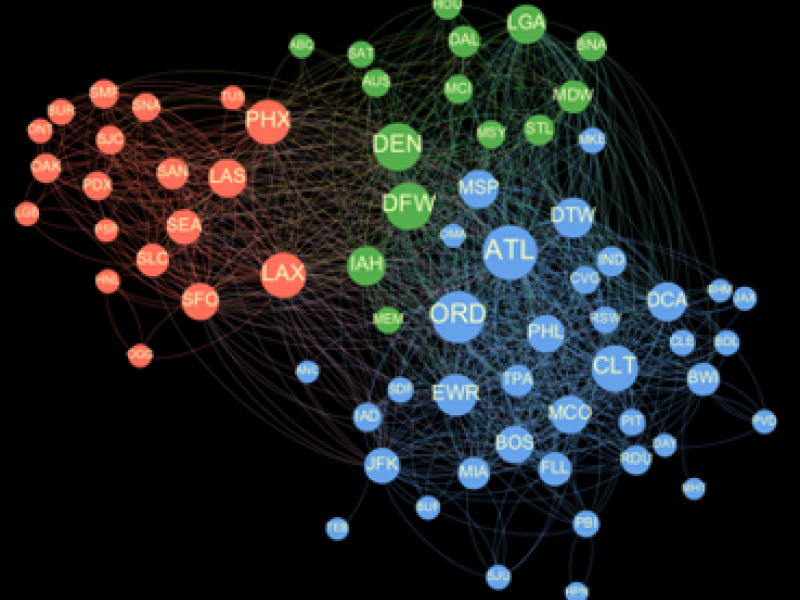
First-of-its-kind network analysis on a supercomputer can speed real-time applications for cybersecurity, transportation, and infectious disease tracking
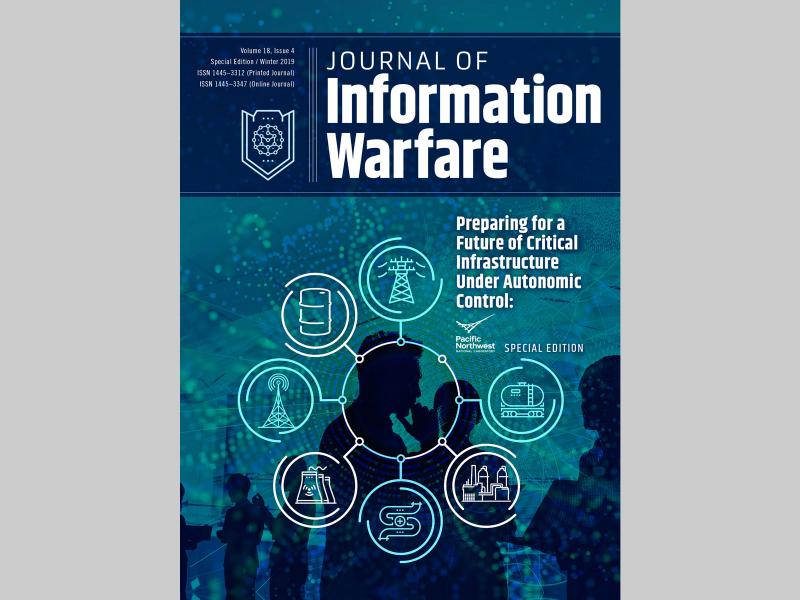
In a special edition of the Journal of Information Warfare, Pacific Northwest National Laboratory researchers explore the revolution of technologies defending the nation’s critical infrastructure.
PNNL’s Srinivas Katipamula and Nora Wang have received a Northwest Energy Efficiency Alliance award for contributing to the success of Seattle’s Building Tune-Up Accelerator Program.
At a conference featuring the most advanced computing hardware and software, ML in its various guises was on full display and highlighted by Nathan Baker’s featured invited presentation.
A multi-institute research team is exploring ways to improve residential walls across America, making homes warmer and drier and delivering significant energy savings.
Scientists at PNNL are bringing artificial intelligence into the quest to see whether computers can help humans sift through a sea of experimental data.
In today’s digital age, the rabbit hole of connected information can be not only a time sink, but downright overwhelming. Even for high-performance computers.
Twenty-four analysts from U.S. intelligence organizations met in August for a machine learning activity with PNNL researchers Nicole Nichols, Jeremiah Rounds, Lawrence Phillips, and Brian Kritzstein.
Trouble on the electric grid might start with something relatively small: a downed power line, or a lightning strike at a substation. What happens next?
A PNNL technology enables automated Economic Dispatch, which coordinates the use of energy in a manner that enhances distributed generation, efficiency, renewables, and grid reliability.
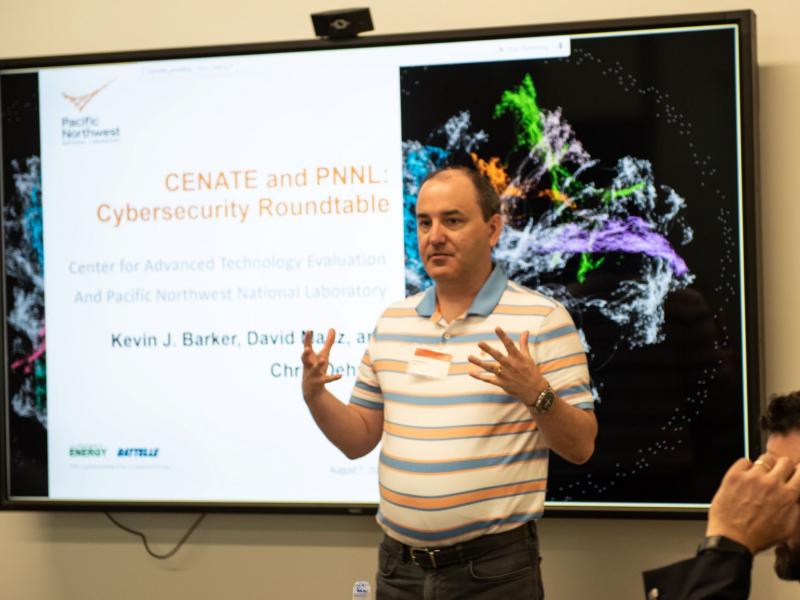
Pacific Northwest National Laboratory is leading efforts to address next-generation computing’s critical role in protecting the nation from cybersecurity threats.
Researchers at PNNL are applying deep learning techniques to learn more about neutrinos, part of a worldwide network of researchers trying to understand one of the universe’s most elusive particles.
Researchers at PNNL construct a novel approach that requires less field work while delivering critical information on building code compliance and energy efficiency in new homes.
PNNL researchers Jianming Lian, Karanjit Kalsi, joint appointee Wei Zhang, and former PNNL intern Sen Li recently received a patent for a market mechanism consisting of novel bidding and clearing strategies.
Scientists created a fast-track tutorial that equips a neural network to tackle drug discovery and other applications where there's a shortage of precisely labeled chemical data.