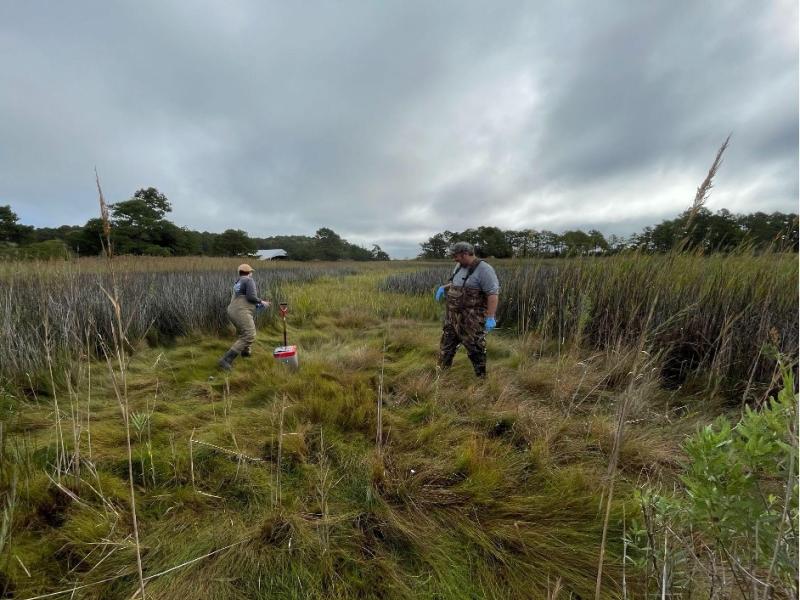
This research explores how changes in groundwater levels affect the chemistry of underground water, especially in areas where land meets water, like wetlands.
PNNL researchers have developed a new, physics-informed machine learning model that accurately predicts how heat accumulates and dissipates during friction stir processing.
This work shows that linear pattern scaling is an effective means of obtaining global-to-local relationships for CMIP6 models, as it has been in past model eras.
In a recent publication in Nature Communications, a team of researchers presents a mathematical theory to address the challenge of barren plateaus in quantum machine learning.
Cloud and its radiative effect are among the determining processes for the energy balance of the global climate; they are also the most challenging processes for the climate models to simulate.
At the Joint Statistical Meeting, the largest gathering of statisticians and data scientists in North America, PNNL researchers presented their latest findings and led a workshop on text analysis and natural language processing.
PNNL staff in the Artificial Intelligence and Data Analytics division were recognized by the TSA’s Innovation Task Force (ITF) for their contributions to cloud capabilities, development strategies, and smart management of cloud resources.
A team of researchers from Pacific Northwest National Laboratory and the Environmental Molecular Sciences Laboratory developed a new and flexible software tool called “Advanced Spectra PCA Toolbox.”
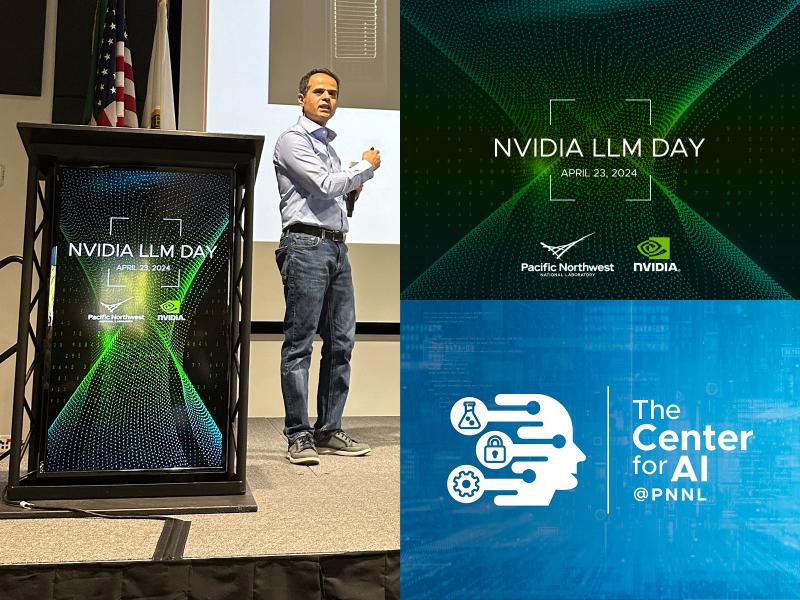
The Lab’s newly formed Center for AI, in partnership with NVIDIA, recently hosted a joint “LLM Day.” During the day, NVIDIA AI experts engaged with PNNL scientists on opportunities to make generative AI a powerful tool for science.
PNNL played host in mid-May to the Artificial Intelligence for Robust Engineering & Science workshop, an annual event that explores advances in artificial intelligence
Scientists at PNNL harnessing advances in deep learning, deep reinforcement learning and generative AI to change how science is conducted and achieve original scientific results and breakthroughs.
Study explores Exploration of Coastal Hydrobiogeochemistry Across a Network of Gradients and Experiments, a consortium of scientists interested in the exchange between water and land in coastal systems.
PNNL computing experts Robert Rallo and Court Corley contribute their knowledge to a recent DOE report on applications of AI to energy, materials, and the power grid.