Technology Overview
Passive acoustic monitoring uses hydrophones—underwater microphones that record sound. Hydrophones help characterize underwater acoustic conditions, monitor marine life, and support research and operations in offshore and riverine conditions. However, obtaining reliable acoustic measurements in high-current conditions is difficult because turbulent water flowing past a hydrophone generates low-frequency pressure fluctuations, known as flow noise.
This nonacoustic noise can mask sounds of interest, limiting the quality of passive acoustic monitoring data at low frequencies (<1 kHz). Hydrophone flow shields can reduce these flow-induced pressure fluctuations, enabling more reliable acoustic measurements in energetic aquatic environments.
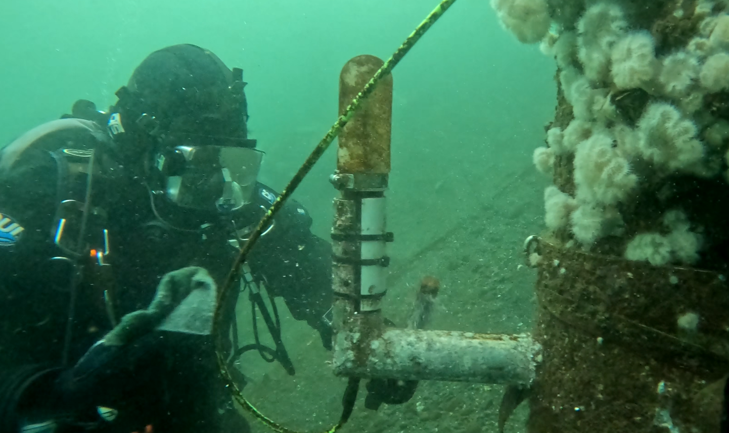
Because of the limited quantitative data currently available on hydrophone flow shield performance, Pacific Northwest National Laboratory’s (PNNL’s) Triton Initiative developed the Flow Noise Mitigation project and conducted a side-by-side performance comparison of three hydrophone flow shield designs aimed at reducing the effects of flow noise while allowing underwater sound to be recorded.
Two designs were fabric-based shields of thin nylon and ballistic nylon that acted as flow straighteners. A third design was an oil-filled enclosure that increases the effective sensing volume of the hydrophone, reducing sensitivity to turbulent pressure fluctuations. These approaches are intended for use where relocating sensors to low-flow areas or using drifting hydrophone platforms is impractical.
The three flow shield designs were evaluated side-by-side during a field deployment in a tidal channel with currents up to approximately 1.3 meters per second. The study compared the three hydrophone flow shield designs against an unshielded hydrophone under identical conditions. All three designs reduced flow noise, demonstrating their ability to improve acoustic measurements in energetic conditions.
The oil-filled enclosure provided the greatest reduction in low-frequency flow noise, reducing flow noise by more than 30 decibels at 40 hertz (Hz) under peak flow conditions. The ballistic nylon shield achieved similar performance at frequencies above approximately 80 Hz. The data indicated that none of the flow shields significantly attenuated sounds of interest at frequencies below 20 kilohertz (kHz).
These results provide quantitative performance data that can help researchers and practitioners select appropriate flow shield designs for passive acoustic monitoring in high-current marine and riverine environments. In addition, these results led to support from the Department of Energy (DOE) Technology Commercialization Fund to conduct further testing and investigate the commercialization of the oil-filled flow shield with Triton’s industry partner, XFlow Energy.
APPLICABILITY
Hydrophone flow shield technology can be integrated into commercial underwater acoustic monitoring systems or offered as an accessory for existing hydrophones. Potential customers include hydrophone manufacturers, oceanographic instrumentation companies, marine energy developers, and research organizations that require reliable passive acoustic measurements in high-current conditions. By reducing flow-induced measurement noise, the technology expands the range of environments where hydrophones can collect usable low-frequency acoustic data.
For more information, please contact commercialization@pnnl.gov.
Advantages
- Reduces flow-induced noise that can mask low-frequency underwater sounds.
- Improves the ability to monitor acoustic environments at fixed monitoring stations in high-current locations.
- The oil-filled enclosure demonstrated the greatest flow-noise reduction in field testing, while ballistic nylon provided similar performance at higher frequencies.
- Can be adapted for hydrophone-based monitoring applications where conventional low-flow deployment locations are unavailable.