June 30, 2026
Research Highlight

How Proteins Fine-Tune Nature’s Iron-Sulfur Electron Relays

Protein and water environments set the overall redox scale of iron-sulfur clusters, but local coordination geometry fine-tunes the final potential
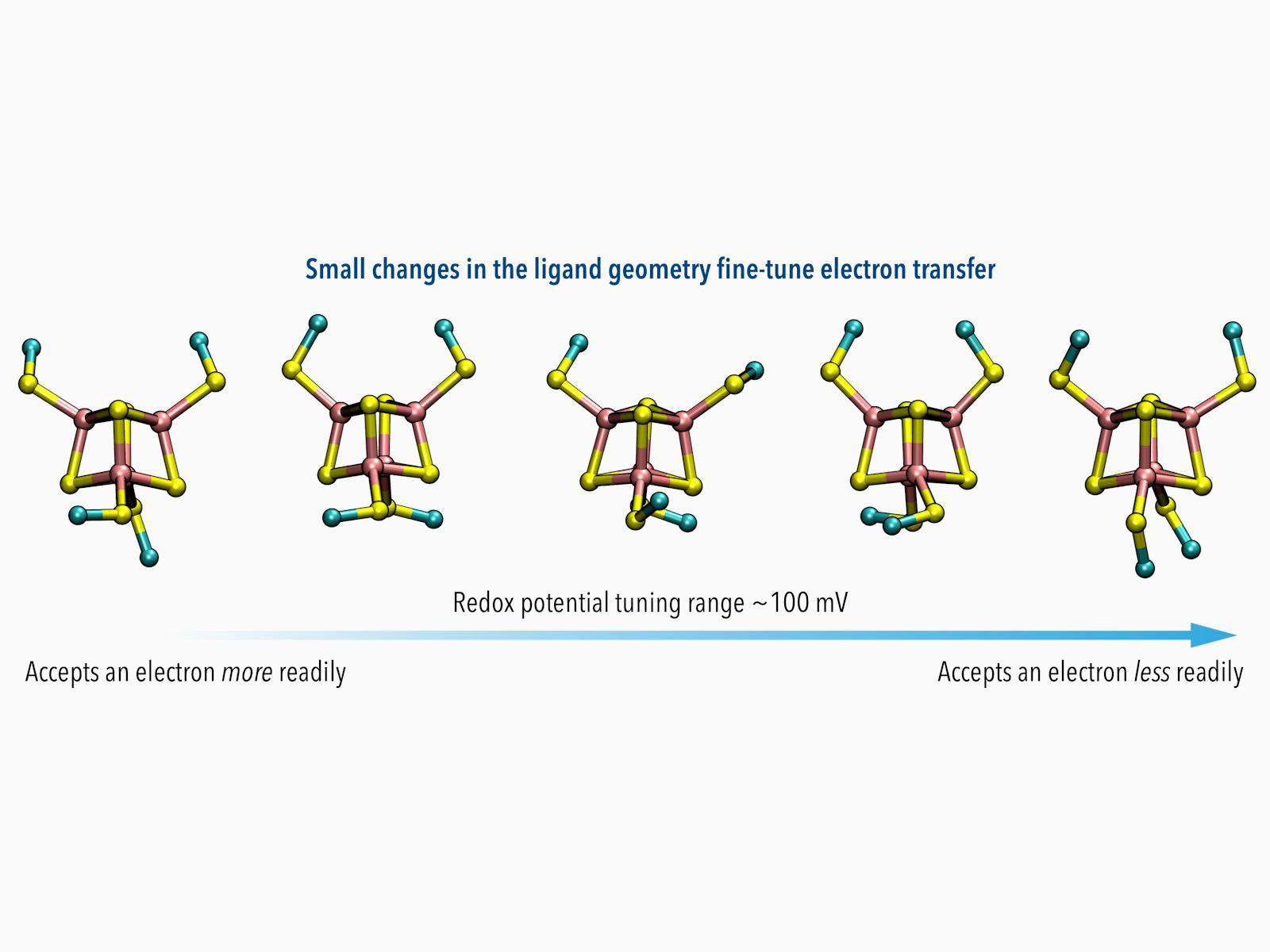
Figure showing different cluster structures

While the dominant cysteine thiolate ligand motif (left) accounts for ~75% of the observed structures, the less common motifs shift the calculated gas-phase redox potential by up to ~0.1 V.

(Image by Simone Raugei | Pacific Northwest National Laboratory)

The Science

Across nature, iron-sulfur clusters move electrons within enzymes to facilitate chemical reactions. Despite the persistence of a common [4Fe–4S] core, the individual enzymes operate across a wide range of redox potentials. Researchers studied over 1,000 protein structures to identify structural differences and determine whether they correlate with redox changes. They found five arrangements of the cysteine ligands surrounding the cluster, which showed shifts in the redox potential of up to 0.1 V. These ligand arrangements may therefore be an important route for tuning the activity of the cluster. The broader protein scaffold and water environment are the largest influence on the overall redox properties of the cluster, leading to the set point around which ligand orientation can perform fine-tuning.

The Impact

Iron-sulfur clusters play a key role in biological electron transfer across a wide range of redox potentials. Researchers have studied these clusters to try to understand how the same cluster can operate at such different potentials. This work uses computational methods to separate the contributions of three properties: ligand geometry, spin coupling, and environmental dielectric response. By parsing the level of influence of these contributions, these results provide guidance to help researchers develop new bio-inspired catalysts with precisely targeted redox properties.

Summary

Iron-sulfur clusters are among nature’s oldest and most widely used motifs to move electrons through proteins. A compact [4Fe–4S] core operates across a broad range of redox potentials, allowing it to serve in many different biological energy-conversion processes. This study asked how proteins achieve that versatility. By analyzing 1,049 nonredundant protein structures, the researchers identified five recurring arrangements of the cysteine ligands that anchor the cluster. Quantum-mechanical calculations then showed that these local coordination geometries can shift the intrinsic redox potential by approximately 0.1 V relative to the most common arrangement.

The broader protein and water environment produces the largest overall change relative to the isolated cluster, effectively setting the operating range of the cofactor. The local coordination geometry then acts as a fine-control mechanism within that range. Although a shift of 0.1 V may appear modest, it can substantially alter the thermodynamic driving force, direction, and biological efficiency of electron transfer. The findings, therefore, reveal a hierarchical design principle used by proteins: the surrounding environment provides broad electrostatic control, while subtle changes near the metal center provide precise functional tuning. This understanding can improve predictions of biological electron-transfer pathways and inform the design of bio-inspired catalysts and redox-active materials.

Contact

Simone Raugei, Pacific Northwest National Laboratory, simone.raugei@pnnl.gov 

Funding

The density functional theory (DFT) calculations for this research were made possible by support from the Generative AI for Science, Energy, and Security Science & Technology Investment provided under the Laboratory-Directed Research and Development Program at Pacific Northwest National Laboratory (PNNL). Statistical analysis of Protein Data Bank structures, as well as the interpretation and analysis of DFT simulations, received support from the U.S. Department of Energy (DOE), Office of Science, Basic Energy Sciences program, Division of Chemical Sciences, Geosciences, and Biosciences. This work was specifically funded through the Physical Biosciences Program under award FWP 66476 (S.R. and M.B.). A portion of the research was conducted using resources provided by Research Computing at PNNL. PNNL is a multiprogram national laboratory managed and operated by Battelle on behalf of the DOE, under Contract No. DE-AC05-76RLO 1830.

Published: June 30, 2026

Rice PS, Jacob B, Agarwal K, Baer MD, Raugei S. 2026. “Geometry, Spin Coupling, and Dielectric Control of Redox Potentials in [4Fe-4S] Clusters,” Journal of Biological Inorganic Chemistry. DOI: 10.1007/s00775-026-02151-2, 10.21203/rs.3.rs-8059723/v1.