June 30, 2026
Research Highlight

Controllable Distribution of Metal Cations in Zeolites

Developed a method for selectively anchoring diverse divalent metal cations in zeolites, important for precise control over catalytic materials
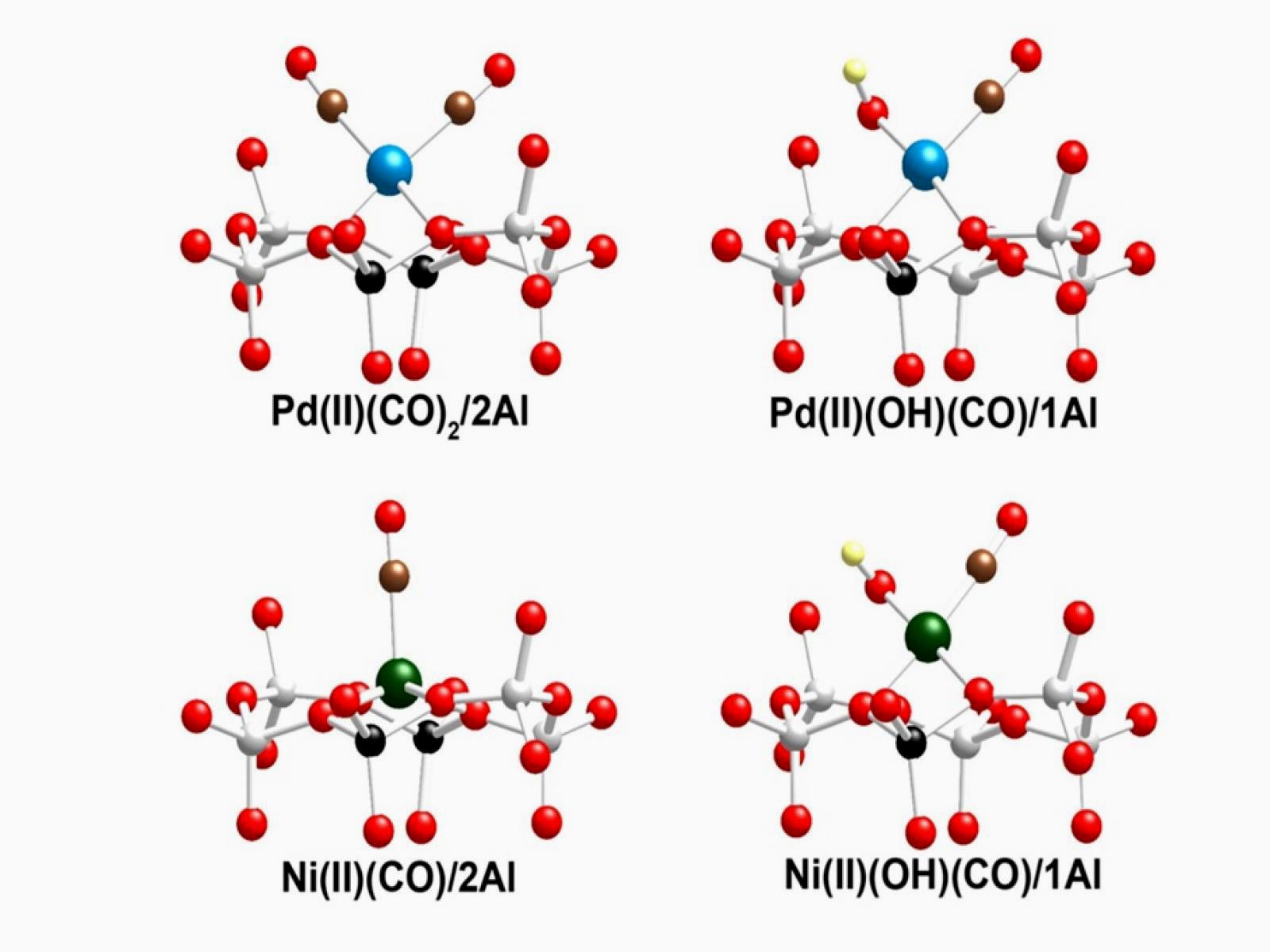
image showing different molecular structures

Precisely synthesized zeolites showed profound differences in reactivity in carbon-carbon bond formation, carbon-hydrogen functionalization, and other catalytic and adsorptive processes, depending on the location of metal atoms.

(Image by Konstantin Khivantsev | Pacific Northwest National Laboratory)

The Science

Zeolites are highly stable materials used across industries as catalysts for chemical reactions ranging from olefin dimerization to the conversion of methane into methanol. Leveraging zeolites to their full potential requires understanding and controlling their full structure. Researchers discovered a way, through precise manipulation of the zeolite framework aluminum (Al) atom placement, to selectively anchor diverse divalent metal cations in zeolites as either isolated ions or isolated ions with a single hydroxyl group attached to them. The team developed a synthetic, spectroscopic, and theoretical framework to fingerprint the signatures of these cations. The new zeolites showed profound differences in reactivity in carbon-carbon (C-C) bond formation, carbon-hydrogen (C-H) functionalization, and other catalytic and adsorptive processes, depending on the bonding of metal ions.

The Impact

To develop more active and selective catalysts, researchers need to control and understand their structure at the atomic level. This work helps solve the problem of accessing precise manipulation or metal atoms in zeolites. Divalent ions had previously remained challenging to add to Al-based zeolites with the requisite level of control. But this work developed an approach to add divalent ions as either isolated metal sites or metal sites with a single -OH group attached to them. By manipulating divalent metal ion attachments, the researchers revealed new chemistry as both types of complexes are active for different reactions.

Summary

Zeolites are an important class of materials used as both active industrial catalysts and well-defined model systems. Adding divalent metal ions into a zeolite in multiple configurations enabled researchers to compare the intrinsic reactivity of the species but required the development of an approach to precisely add the ions into the zeolite. A research team used deep expertise in zeolite synthesis to prepare zeolites with variable Al atom placements. They were able, for the first time, to selectively place divalent metal cations in a zeolite either as “isolated” ions or as ions with a single -OH bond attached to them. The team then spectroscopically characterized the zeolites with infrared and electron paramagnetic resonance spectroscopy to develop a series of spectroscopic fingerprints. They also used theoretical calculations to create a more robust understanding of the spectroscopic fingerprints of the different sites. They then compared the different sites’ reactivity for model C-C bond formation and C-H functionalization reactions. The team found that the sites have profoundly different reactivity in multiple important catalytic reactions. This work reveals previously unexplored mechanistic details for C-C couple and C-H bond functionalization reactions.

Contact

Konstantin Khivantsev, Pacific Northwest National Laboratory, konstantin.khivantsev@pnnl.gov 

Zdenek Dohnalek, Pacific Northwest National Laboratory, zdenek.dohnalek@pnnl.gov

Funding

KK, MAD, EDW, DB, TRG, LK, and JSz: Department of Energy, Office of Science, Basic Energy Sciences program, Division of Chemical Sciences, Geosciences, and Biosciences, under the project “Advancing Key Catalytic Reaction Steps for Achieving Carbon Neutrality” (FWP 47319), provided support for synthesis, infrared spectroscopy, electron paramagnetic resonance spectroscopy, nuclear magnetic resonance spectroscopy, and catalytic measurements.

YW, DJD, and GL: Department of Energy’s Vehicle Technology Office: provided support for selective catalytic reduction measurements.

KK, NRJ, and MAD: Quickstarter Initiative Laboratory Directed Research and Development (Pacific Northwest National Laboratory) provided support for synthesis of the starting materials.

HAA, GNV, IZK, and NRJ: European Union-NextGenerationEU, through the National Recovery and Resilience Plan of the Republic of Bulgaria, project no. BG-RRP-2.004–0008; UNITe BG16RFPR002-1.014–0004, funded by Program Research, Innovation and Digitalisation for Smart Transformation (PRIDST). The computational resources were provided by Discoverer supercomputer of SofiaTech Park. Support was provided for theoretical calculations.

Published: June 30, 2026

N. R. Jaegers, M. A. Derewinski, E. D. Walter, I. Z. Koleva, D. Boglaienko, D. J. Deka, G. Lee, T. R. Graham, L. Kovarik, Y. Wang, J. Szanyi, H. A. Aleksandrov, K. Khivantsev. 2025. Angew. Chem. Int. Ed., 64, e202516086, DOI:10.1002/anie.202516086