TREADS
TREADS
An adaptable framework for threat risk event analysis, detection, and surveillance

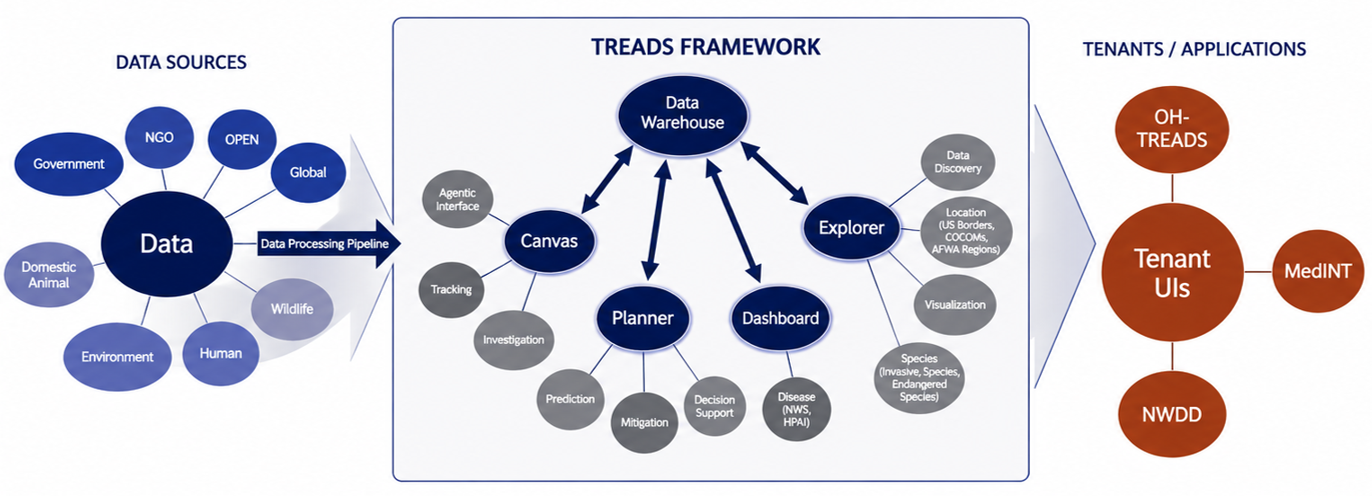
The Threat Risk and Event Analysis, Detection, and Surveillance framework offers an adaptable capability to meet new and changing threats compromising human, animal, plant, and environmental health.
(Image composition by Melanie Hess-Robinson | Pacific Northwest National Laboratory)
The future of health security relies on stronger situational awareness, better predictive understanding, and seamless sharing of health-related information across sectors. Developed by Pacific Northwest National Laboratory (PNNL), the Threat Risk and Event Analysis, Detection, and Surveillance framework (TREADS) offers an adaptable capability to meet new and changing threats compromising human, animal, plant, and environmental health, including:
- Situational awareness of current threats
- Early warning and risk assessment of unusual events
- Prediction of upcoming threats and contributing factors.
With enhanced cross-agency coordination, integrated multi-domain data, and AI-driven analysis, the health security community can move from reactive response to proactive detection, enabling faster identification of emerging threats, stronger national preparedness, more coordinated operational decision-making, and ultimately better protection of communities, critical infrastructure, and individual citizens.
Enabling AI-driven One Health security
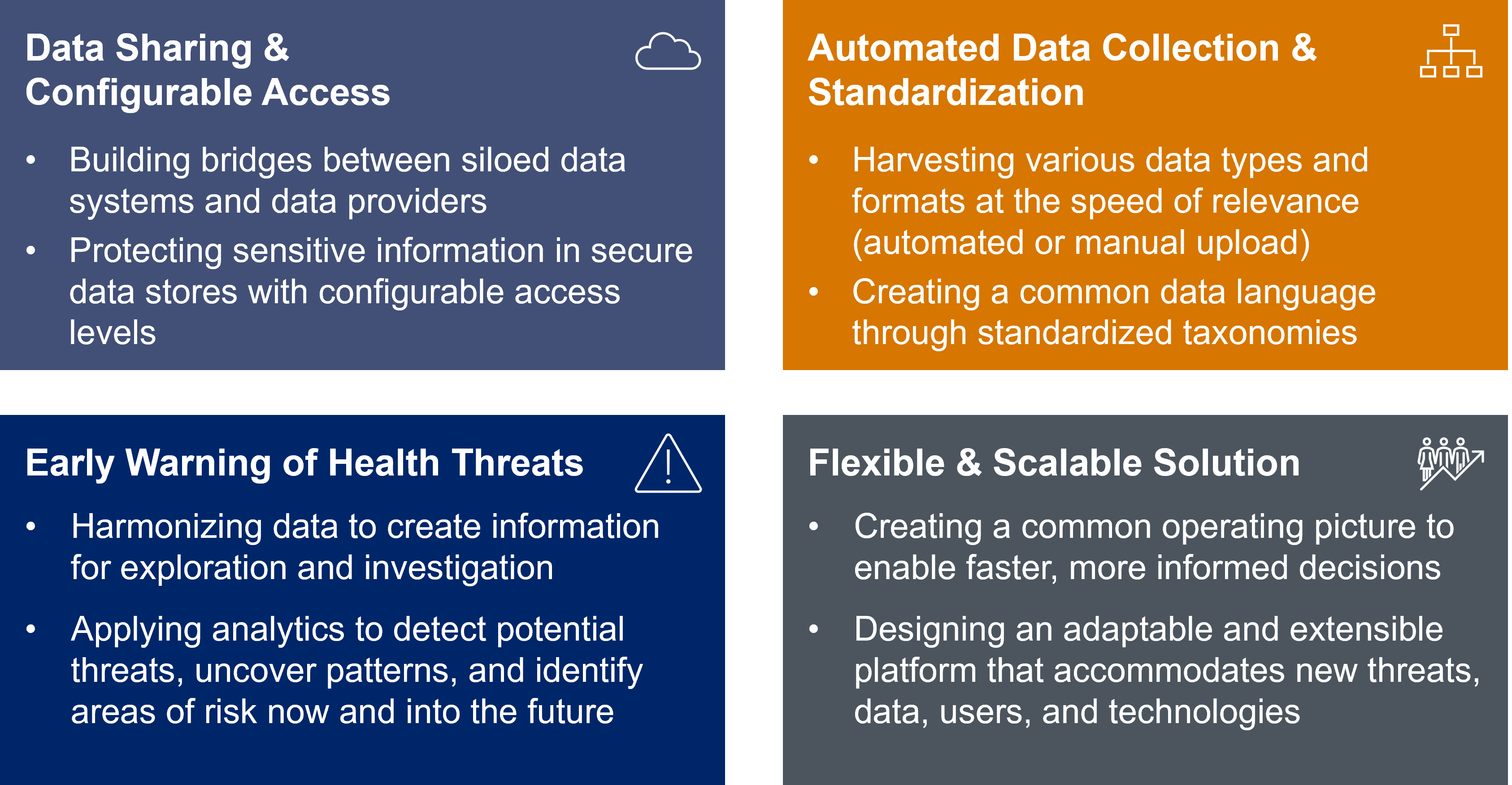
TREADS is the backbone to a flexible and scalable early warning system that enables secure data sharing, rapidly integrates diverse data types, and adapts to evolving users, analytics, and mission needs.
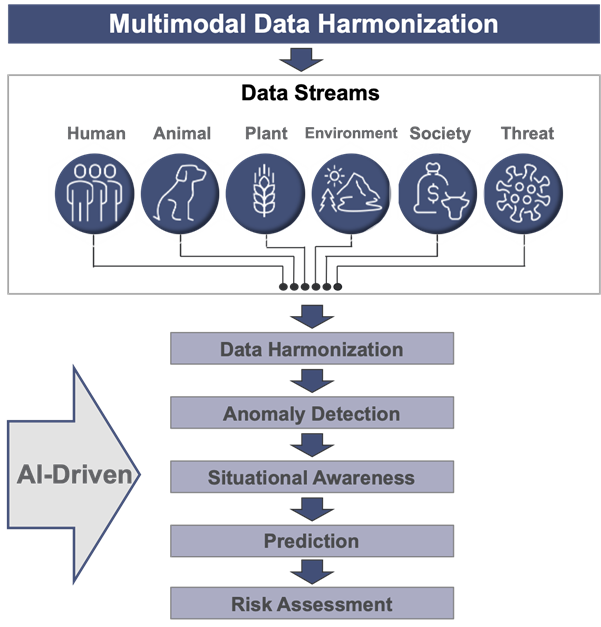
Built on PNNL’s AI-Driven One Health Security approach, TREADS utilizes novel, multimodal data harmonization techniques to analyze, detect, and interpret vast arrays of heterogeneous data from various domains. TREADS provides secure and configurable data sharing, seamlessly integrating various data types at the speed of relevance, leading to better anomaly detection, situational awareness, prediction, and true risk assessment. Across all its inputs, the framework leverages AI to derive actionable insights, uncover patterns, and forecast potential direct or indirect health threats.
Flexible, scalable solutions fit for domains
The TREADS framework is built to be scalable and flexible to new data and analytics, as well as multiple types of end users and use cases. PNNL has built trusted partnerships with data providers and federal sponsors that have resulted in the TREADS framework being fit to different multidomain priorities.
Recent examples of sponsor- and mission-specific applications include:
- MedINT is a medical intelligence tool focused on human medical operations. The tool takes an all-source approach for event detection that includes open-source news and reports, scientific literature, human and animal health, and severe weather events to gain global situational awareness of potential national health threats.
- One Health TREADS focuses on enabling U.S. states to effectively share health data between agencies. One Health TREADS uses sophisticated data sharing, standardization, and harmonization techniques to enable insights drawn across human, society, animal, environmental, and pathogen/vector data. The platform can create risk maps of current disease threats and forecast future disease states, even when there is a lack of data and data bias in disease counts.
- The National Wildlife Disease Database system is targeted for natural resource managers up to federal agencies. It focuses on situational awareness, anomaly detection, and predictive analytics across a range of One Health data sources. The main driver is to identify health threats in wildlife before spillover to humans and domestic or agricultural animals.
- PNNL is working with the Centers for Disease Control and Prevention to develop Public Health TREADS, a mission-specific deployment of TREADS designed to integrate and harmonize approved public health and complementary data sources. PH-TREADS will enable users to explore information across sources, identify emerging patterns, and evaluate analytics supporting situational awareness and early warning. The platform is designed to strengthen collaboration while preserving data-owner authority through defined access, use, and sharing controls.
A full list of PNNL’s AI-driven One Health tools and projects is available here.
Delivering secure, seamless integration
TREADS combines different types of data and AI/machine learning techniques to provide situational awareness, threat prediction, and risk assessment to a variety of end users. Key advantages of the TREADS framework include:
- Data sharing and access are secure and configurable based on a data provider’s preferences and requirements.
- Various data formats are seamlessly integrated automatically at the speed of relevancy for that data.
- Current capabilities are easily scalable and flexible to include new data types and analytics.
- User interface components can accommodate multiple types of users and meet specific use cases and needs.
A vision for the future
The long-term goal for TREADS is to develop a secure, global platform that:
- Creates interoperability of data sources across the One Health landscape
- Provides real-time situational awareness of potential and emerging health threats
- Builds upon trustworthy and explainable AI predictions
- Supports machine-augmented decision-making
- Enables information sharing and collaboration across government, academia, nongovernmental organizations, international organizations, and the public.
“By utilizing the power behind both One Health and AI, we can enable better anomaly detection, situational awareness, prediction, and true risk assessment.” – Lauren Charles, Chief Data Scientist of AI-Driven One Health Security at PNNL