Northwest Biopreparedness Research Virtual Environment (NW-BRaVE) Initiative
Northwest Biopreparedness Research Virtual Environment (NW-BRaVE) Initiative
Supporting innovations in data analytics, instrumentation, and experimental techniques for the development of new approaches for disease detection, targeted therapy design, and antipathogen materials.

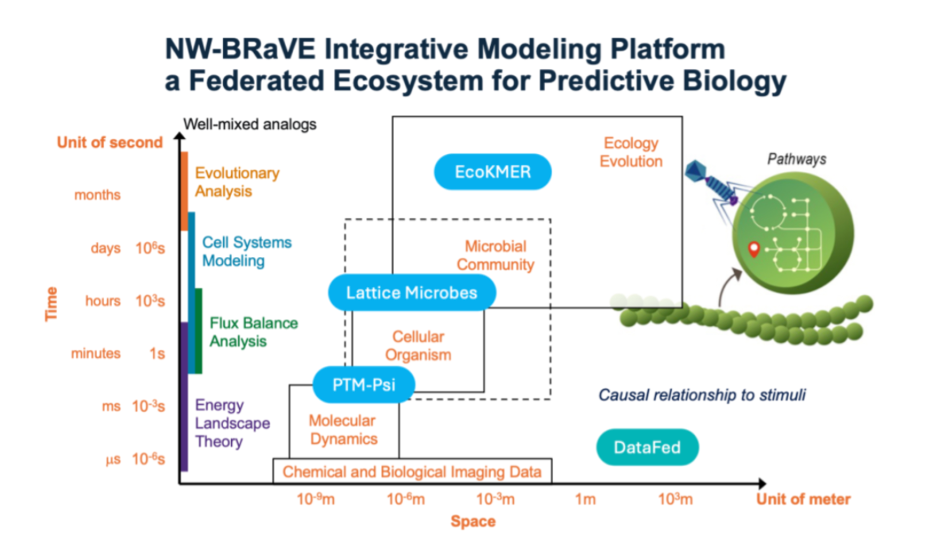
The science of biopreparedness to counter biological threats hinges on understanding the fundamental principles and molecular mechanisms that lead to pathogenesis and disease transmission. To address this, a multi-institutional team of researchers led by Pacific Northwest National Laboratory (PNNL) is creating a powerful and user-friendly platform to reveal the fundamental principles of how molecular interactions drive pathogen-host relationships and host shifts.
This effort comprises the Northwest Biopreparedness Research Virtual Environment (NW-BRaVE) initiative.
Mission
The mission of the BRaVE initiative is to design and lead new approaches for disease detection, targeted therapy design, and the development of antipathogen materials. NW-BRaVE at PNNL supports innovations in data analytics, instrumentation, and experimental techniques through capabilities in physical, computational, and biological sciences.
Study virus-host interactions like never before
The new platform being built by NW-BRaVE will allow researchers to study virus-host interactions in ways that haven’t been possible before. It will help scientists predict how viruses adapt to hosts over time, enabling timely interventions to stop future biological threats.
Designed to work for a wide range of systems, the project helps prepare society to handle challenges from newly emerging viruses.
Advanced tools to uncover patterns and principles
By using photosynthetic cyanobacteria and their viruses, called cyanophages, as a model, researchers can explore how molecular interactions shape these relationships. The project combines advanced tools like genomics, proteomics, and artificial intelligence to uncover patterns and principles that can be applied to many other host-virus systems, helping scientists better understand and respond to biological challenges.
The project focuses on four main goals:
- Visualize molecular structures
Reveal the molecular complexes that comprise the cyanobacteria redox macromolecular subsystem and how they dynamically change with bacteriophage infection in situ using cryo-electron tomography. - Map changes during infection
Profile regulatory changes during infection using proteomics, multiomics, and experimental validation, and integrate the data with in situ structures. - Track environmental and population factors
Use genomics and metagenomics to determine environmental and population factors that affect the interactions between marine cyanobacteria and their cyanophage parasites across time scales, predicting the evolutionary origins of in situ structural and functional interactions, convergence, and coevolution. - Surveil virus-host interactions and launch a new platform
Develop a data integration and transformation platform that facilitates the integration of in situ, proteomic, and evolutionary measurements of molecular interactions to surveil hosts and pathogen interactions in various environmental contexts.
Together, this work provides a way to monitor and study host-virus relationships, even in complex and changing environments.
This work is supported by the Department of Energy, Office of Science, Biological and Environmental Research program.