What can GSL testing do for you?
We invite all vendors with battery technology to use the GSL to test and validate the performance of their systems under grid-scale conditions. This service does not fulfill certifications or test to failure states, but it helps verify operational performance by the specifications in the system’s design. GSL testing informs:
- Battery OEM (Original Equipment Manufacturer), system integrators, and developers wanting third-party validation of system performance,
- Utility owners/operators, and grid managers who need to validate deployment of new technology and lessen the risk of asset performance,
- Grid planners who manage industry specifications,
- Researchers investigating new battery materials and their grid contribution,
- Anyone with an eye on U.S. grid resiliency.
GSL’s Testing and Validation Capability
Companies with systems in production or pre-commercial phases can apply to test their technologies at the facility in Richland, Washington, using two Testing and Validation (T&V) environments designed specifically for battery technologies from cells to systems.
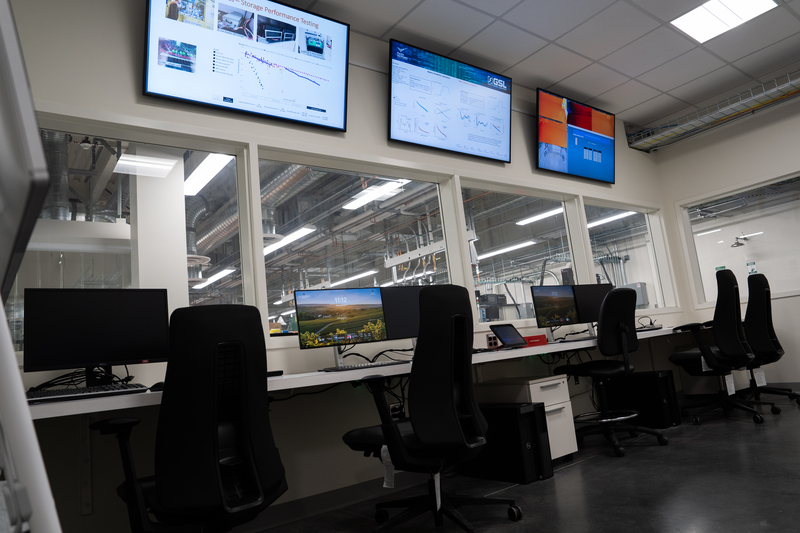
Lab 1 (T&V1) – testing cells and modules
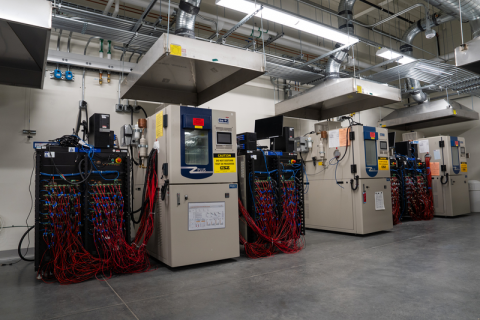
T&V1 is designed specifically for testing cells and modules.
This environment offers an expansive space for 16 test stands to handle systems of different chemistries—flow batteries, sodium batteries, zinc-based, lithium ion, lead acid—at 10 kilowatt (kW) and up to 40 kilowatt hours (kWh) for pre-commercial systems.
While this space is not currently accepting testing applications, you can review specifications and contact our team for more information regarding testing conducted in this room.
Lab 2 (T&V2) – testing grid-scale systems
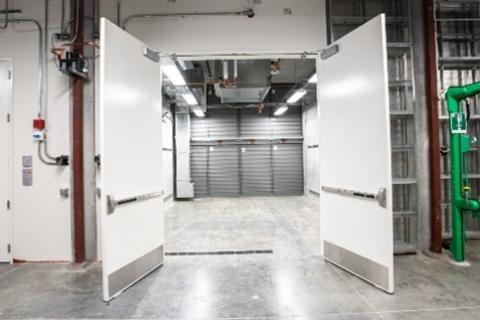
T&V2 is designed to test larger-scale systems’ performance under designer specifications—prototypes and unit-level systems—with dedicated test rooms that can accommodate battery systems up to 100 kW and 400 kWh for validation of equipment at scales relevant to grid storage.
Safety is a priority with the design of these testing rooms. They are equipped with a highly engineered safety system and cameras that monitor for events such as thermal run-away or off-gassing of the battery. We do not test to failure (i.e., destructive testing) in T&V2.
Refer to our test room guidance for information on doorway access, floor space allowance, and terminal connections.
Your Path to Testing in T&V2
You can apply to have your technology tested for optimal performance, security, and reliability. The application you will complete answers key questions that help us determine if GSL testing will work for your system. GSL T&V2 spaces are designed for energy storage technology that performs differently and at varying sizes. Your application will enable us to plan for the appropriate environment and how to work with your system.
Equipment testing can be scheduled upon confirmation of project funding through various financing mechanisms (e.g., DOE Voucher and private funds or another federal funding source) and after we perform a safety review.
Application and Testing Process:
- Prepare and Apply
- Gather all necessary agreements and documentation
- Submit application, agreements and documentation via the online application form
- Application Review
- Technical review of application conducted
- Review of necessary agreements conducted
- Approval notice sent to applicant
- Scheduling of testing procedure(s)
- Testing and Reporting
- Equipment delivered to GSL
- Testing period
- Performance report delivered to owner
- Equipment returned to owner
Subscribe to Our Newsletter
Sign up to be among the first to receive updates on GSL developments, projects, new opportunities, and industry highlights.
Contact Our Team
Learn more about what the GSL can do for you! Email us at GSLtesting@pnnl.gov and tell us what technology you have, where in the development process you are, and if you anticipate testing someday at the GSL.