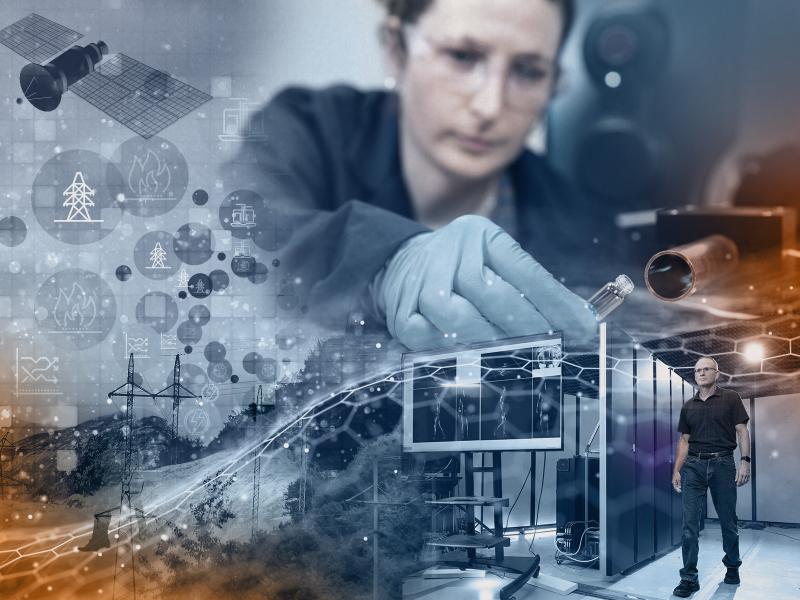
Researchers at Pacific Northwest National Laboratory (PNNL) develop and apply advanced AI systems to accelerate scientific discovery and deliver mission-critical solutions that strengthen science, national security, and energy reliability.
Why AI Matters for Science
AI enables discovery science, advances applied energy technologies, and strengthens national security, helping PNNL address complex challenges and support a safer, more secure, and energy-resilient nation.
Using AI to Advance Discovery Science, Applied Energy Technologies, and National Security
PNNL applies AI across discovery science, applied energy technologies, and national security to accelerate scientific research, strengthen energy technologies, and address complex mission challenges.
In discovery science, these capabilities advance chemistry, materials, and biological systems. In applied energy, they support reliable grid operations and innovation in battery technologies. In national security, they provide situational awareness, threat analysis and detection, online-signal analysis, and assurance guided by cybersecurity architectures for high-consequence systems.
The Center for AI
The Center for AI @PNNL advances groundbreaking AI to unlock scientific discoveries, ensure reliable energy, and strengthen national security.
The Center for AI led PNNL’s participation, along with nine national laboratories, in the Department of Energy’s 1,000 Scientist AI Jam Session. Scientists explored advanced frontier AI models to understand the potential impact of AI reasoning models on national security and science, especially how AI models may accelerate discoveries.
How PNNL Is Building Stronger AI Systems

PNNL is leading the next generation of computing for scientific discovery.
Explore our Computing & AI story
PNNL takes a holistic approach to research focused on assuring the safety, security, interpretability, explainability, and general strength—including cybersecurity architectures and frameworks—of AI-enabled systems deployed in the real world. This research includes understanding and mitigating system failures caused by design and development flaws, as well as the malicious activities of adversaries. We apply cybersecurity frameworks to harden models and pipelines against adversarial threats.
Revealing the reasoning behind deep-learning-based decisions is a critical component of assuring safety, security, and robustness. This reasoning allows our researchers to assess complex systems from the perspective of digital and physical system security, as well as from development and operational perspectives.
Using AI to Forecast Real-World Events
PNNL’s research in content intelligence focuses on the development of novel AI models to explain and predict social systems and behaviors related to national security challenges in the human domain.
AI Tools for Emergency Management
Experts with PNNL’s Northwest Regional Technology Center are exploring the potential of leveraging AI for emergency management—researching opportunities, applications, and existing implementations.
PNNL’s interactive tools like CrossCheck, ESTEEM, and ErrFilter not only ensure we develop robust and generalizable AI models, but also advance understanding and effective reasoning about extreme volumes of dynamic, multilingual, and diverse real-world data.
Integrating Across AI-Related Missions
Data engineering is foundational to data science, focusing on information flow from data sources to real-world application. Combining this capability—including expertise in data architectures and pipelines, data collection, and validation—with AI enables cross-functional teams to provide optimal solutions to critical mission spaces.
Advancing AI Through Next-Gen Computational Infrastructure
Sponsored by the Department of Energy’s Advanced Scientific Computing Research program, PNNL’s Advanced Memory to Support AI for Science project develops advanced memory architectures that enable the convergence of scientific modeling and simulation with AI-enabled data analysis. The work focuses on fabric-attached memory and memory-to-processor configurations that provide the capacity, bandwidth, and shared access needed for memory-intensive scientific applications. The Crete testbed, co-designed with Micron, provides 15 terabytes of active CXL-based memory co-located with system processors. This reconfigurable, memory-rich platform supports the development and evaluation of algorithms and software for AI-enabled chemistry, advanced materials, molecular biology, and other data-intensive science applications.
Mathematics for AI and Computational Innovation for Complex Systems
PNNL leads the Department of Energy’s LEADS SciDAC Institute, which brings together applied mathematics, AI, and scientific computing to develop scalable, domain-informed capabilities for energy, environmental, and national security applications. The institute advances functional analytic and probabilistic methods, geometric algorithms, and performance optimization, with emphasis on foundation models and energy efficiency. PNNL also applies topological data analysis, algebra, and geometry to reveal structure in complex data; strengthen the interpretability, robustness, and explainability of AI systems; and support applications ranging from materials science to the analysis of neural-network behavior.
How PNNL Is Expanding Its AI Capabilities
While almost all research on few-shot learning is done exclusively on images, researchers at PNNL have shown success in other data types, including text, audio, and video. This has greatly expanded our AI capabilities beyond traditional, publicly available image datasets and allows researchers to quickly build ML models using small amounts of user-classified training examples.
AI Systems for Nuclear Forensics
PNNL scientists have tapped generative AI and machine learning, as well as cloud computing resources from Microsoft, to show how AI can help solve some of the complicated chemistry questions that scientists confront when analyzing a mix of radioactive debris from a nuclear explosion.