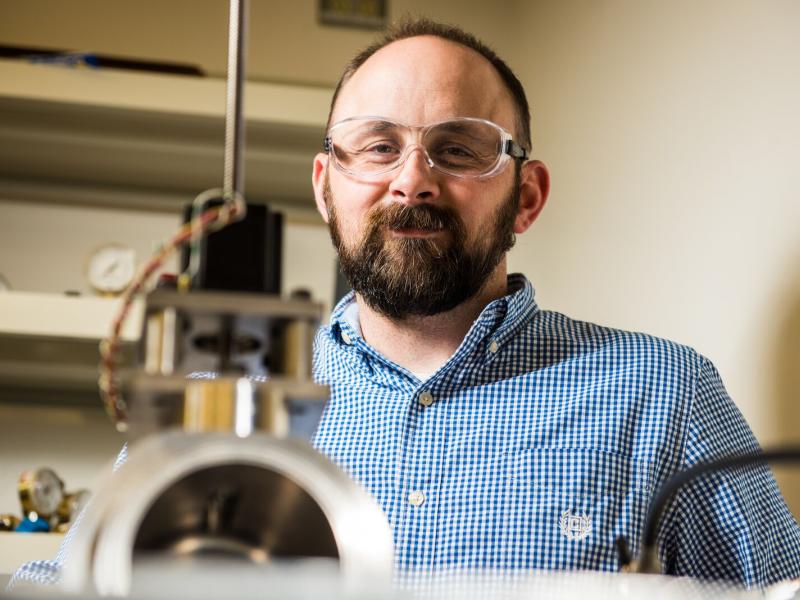
A decade after working as a post-bachelor’s researcher at PNNL, chemist Quin Miller is helping develop the workforce for the critical minerals-focused mines of the future.
Peter Heine, senior advisor in the Strategic Threat Analysis group at PNNL, recently travelled to Brussels, Belgium, to support the World Customs Organization's Operation Stingray.
A team of researchers at PNNL has received the 2025 National Nuclear Security Administration CIO Award for developing an innovative solution to enhance secure communications.
David Heldebrant was selected for the 2025 Distinguished Service Award from the American Chemical Society Division of Energy & Fuels, recognizing his impact to energy and fuels chemistry.
CO2 separation is key for natural gas purification, but conventional techniques are high-emission processes. New research reveals a novel, doubly segmented, CO2-selective membrane that increases CO2 permeability and reduces emissions.
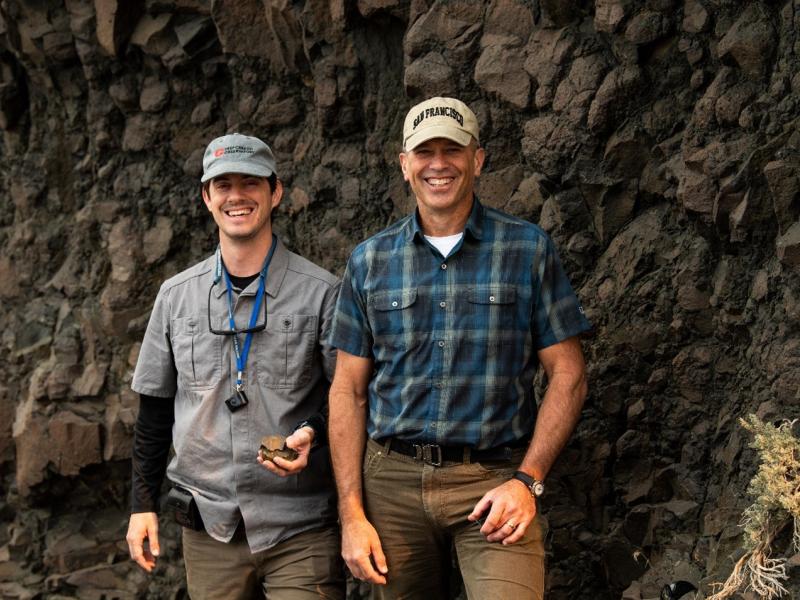
For PNNL’s Jonathan Evarts, Hope Lackey, and Erik Reinhart, this partnership with WSU opened doors and provided opportunities for their scientific careers to flourish.
Led by interns from multiple DOE programs, a newly expanded dataset allows researchers to use easy-to-obtain measurements to determine the elemental composition of a promising carbon storage mineral.
A multi-institutional team of researchers systematically compared extraction techniques for characterizing plant litter composition that relies on organic matter extraction.
Research identifies the mechanisms through which peptoids affect ions in solution and a mineral surface, increasing the rate of carbonate crystal growth.
Staff at PNNL recently traveled to Cyprus to facilitate a multilateral workshop on chemical forensics investigations hosted by the U.S. Department of State, Office of Weapons of Mass Destruction Terrorism.
Staff at PNNL recently visited the University of Texas at San Antonio to deliver lectures on international law, arms control, and nuclear nonproliferation during Nuclear Policy Week.
To improve our ability to “see” into the subsurface, scientists need to understand how different mineral surfaces respond to electrical signals at the molecular scale.