Researchers at PNNL share a research- and practitioner-informed approach to assess the threat landscape, elicit and integrate feedback into solutions, and ultimately share outcomes with the emergency response and public safety community.
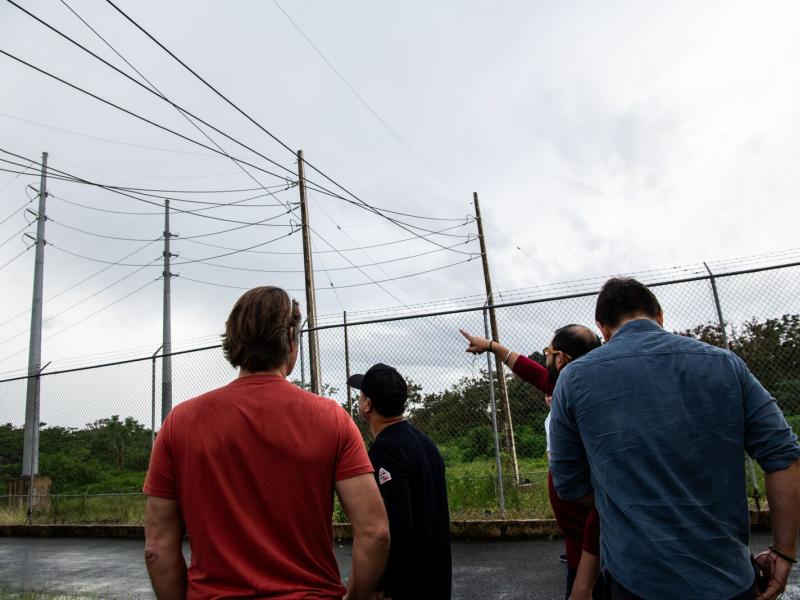
Two new publications provide emergency response agencies with critical insights into commercially available unmanned ground vehicles used for hazardous materials response.
Jonathan Barr, senior systems engineer at PNNL, was recently invited to co-present on a panel at the Texas Department of Emergency Management Annual Conference.
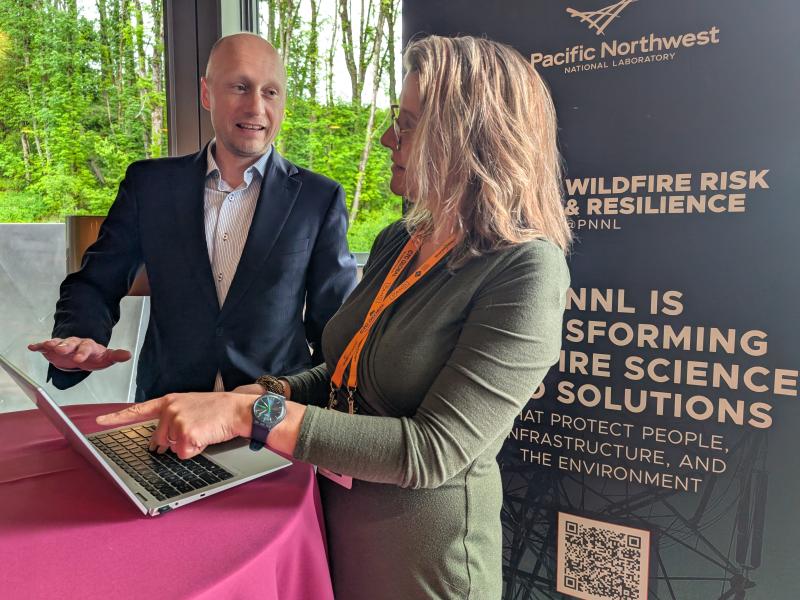
The Wildfire Mitigation Plan Database was built to support electric utilities, state governments, policymakers, and regulators in understanding and improving wildfire risk and resilience strategies.
A team from PNNL contributed several articles to the Domestic Preparedness Journal showcasing recent efforts to explore the emergency management and artificial intelligence research and development landscape.
PNNL Earth scientist Alison Delgado will serve as an author for the “Science of Response Management” chapter of the Sixth National Climate Assessment (NCA6.)
The Grid Storage Launchpad dedication event was attended by leaders in grid and transportation energy storage, battery innovation, and industry stakeholders working to transform America’s energy system.
Researchers found that in a future where the Great Plains are 4 to 6 degrees Celsius (°C) warmer as projected in a high-emission scenario, these storms could bring three times more intense rainfall.
At the National Homeland Security Conference, researchers shared how partnerships and emerging technologies like artificial intelligence can play a key role in emergency management preparedness and response.
Erich Hsieh, Deputy Assistant Secretary for OE’s Energy Storage Division, shared insights about the Grid Storage Launchpad and energy storage innovations .
Once thought to cover too little of the Earth’s surface to affect climate at larger scales, new work finds that city sprawl does add to global warming—over land, at least.
Data scientist at PNNL receives the Environmental and Engineering Geophysical Society and Geonics Limited Early Career Award for work with geophysical modeling and subsurface inversion codes.