Researchers at PNNL share a research- and practitioner-informed approach to assess the threat landscape, elicit and integrate feedback into solutions, and ultimately share outcomes with the emergency response and public safety community.
From developing new energy storage materials to revealing patterns of Earth’s complex systems, studies led by PNNL researchers are recognized for their innovation and influence.
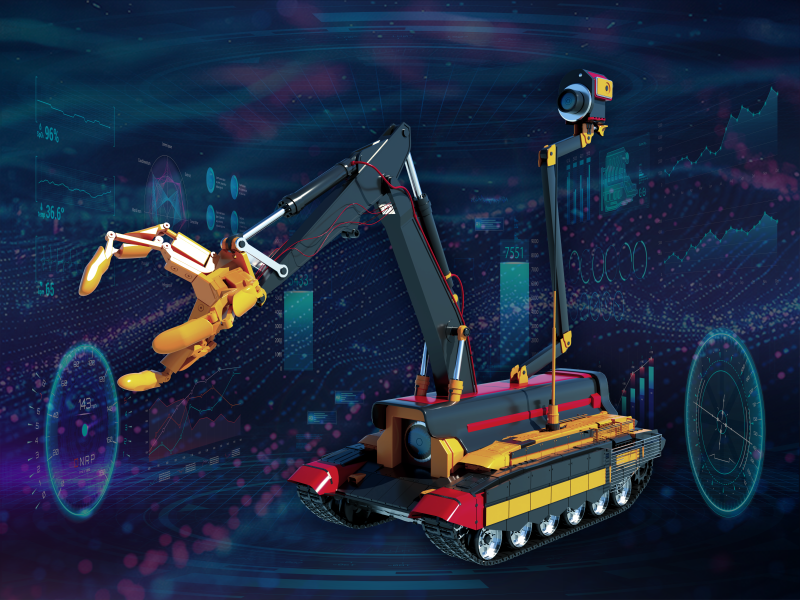
Two new publications provide emergency response agencies with critical insights into commercially available unmanned ground vehicles used for hazardous materials response.
PNNL's E-COMP initiative is helping unleash American energy innovation with advanced theories, models, and software tools to better operate power systems that rely heavily on high-speed power electronic control.
A team from PNNL contributed several articles to the Domestic Preparedness Journal showcasing recent efforts to explore the emergency management and artificial intelligence research and development landscape.
A team of researchers recently coordinated a series of international workshops aimed at enhancing chemical research security and fostering collaboration among scientists and academic researchers from both countries.
PNNL Earth scientist Alison Delgado will serve as an author for the “Science of Response Management” chapter of the Sixth National Climate Assessment (NCA6.)
Over the past three years, PNNL’s Know Your Collaborator (KYC) workshop series has engaged hundreds of academic partners and institutional researchers internationally on the topic of research security.
International compliance analyst Madalina Man highlighted the history of international safeguards on a podcast by the United Arab Emirates Federal Authority for Nuclear Regulation.
Researchers found that in a future where the Great Plains are 4 to 6 degrees Celsius (°C) warmer as projected in a high-emission scenario, these storms could bring three times more intense rainfall.
At the National Homeland Security Conference, researchers shared how partnerships and emerging technologies like artificial intelligence can play a key role in emergency management preparedness and response.
Erich Hsieh, Deputy Assistant Secretary for OE’s Energy Storage Division, shared insights about the Grid Storage Launchpad and energy storage innovations .
Once thought to cover too little of the Earth’s surface to affect climate at larger scales, new work finds that city sprawl does add to global warming—over land, at least.
Data scientist at PNNL receives the Environmental and Engineering Geophysical Society and Geonics Limited Early Career Award for work with geophysical modeling and subsurface inversion codes.