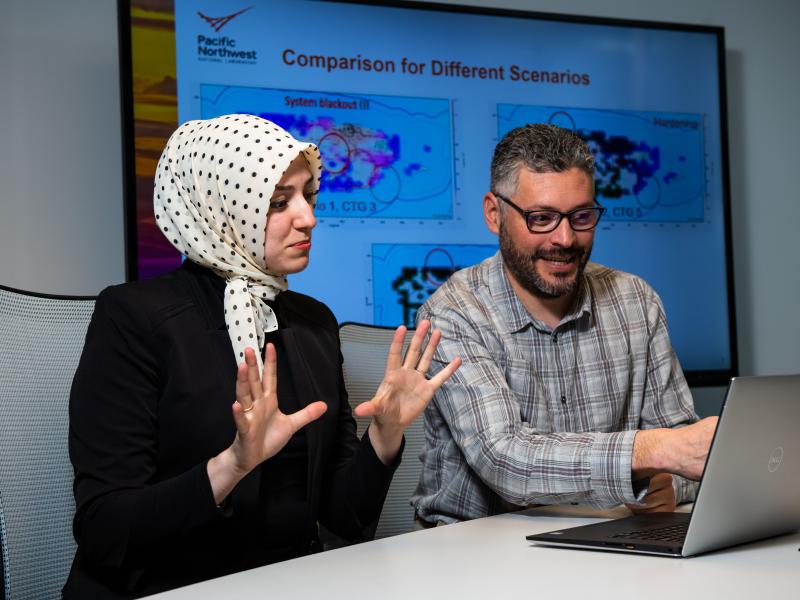
Tools being developed at PNNL are helping the nation plan for, respond to and recover from severe storms and wildfires that could threaten critical energy systems.
PNNL teamed with academia and industry to develop a novel zero-emission methane pyrolysis process that produces both hydrogen and high-value carbon solids suitable for an array of manufacturing applications.
Niri Govind and Amity Andersen co-hosted a workshop to explain how to use theory and modeling in the interpretation of X-ray absorption spectroscopy data.
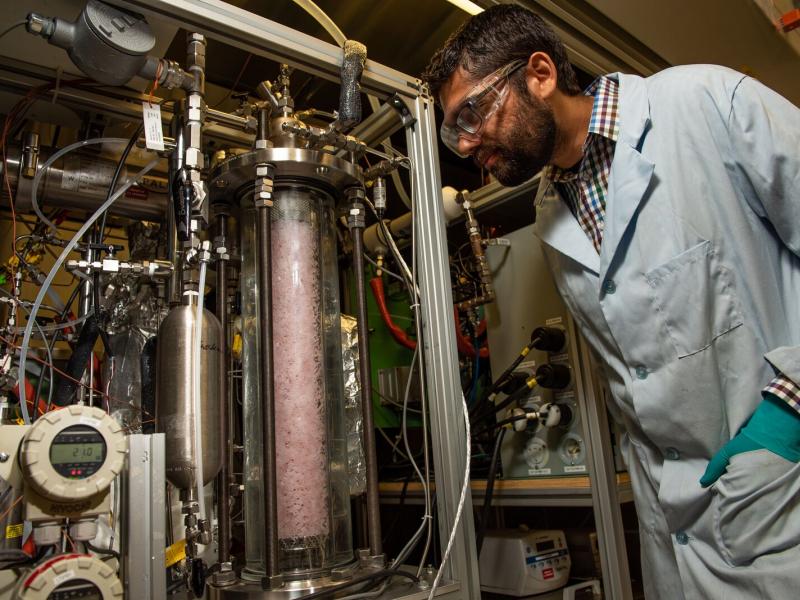
PNNL’s newest solvent captures carbon dioxide from power plants for as little as $47.10 per metric ton, marking a significant milestone in the journey to lower the cost of carbon capture.
New facility that will accelerate energy storage innovation and make the nation’s power grid more resilient, secure and flexible has been given the green light to proceed by the U.S. Department of Energy.
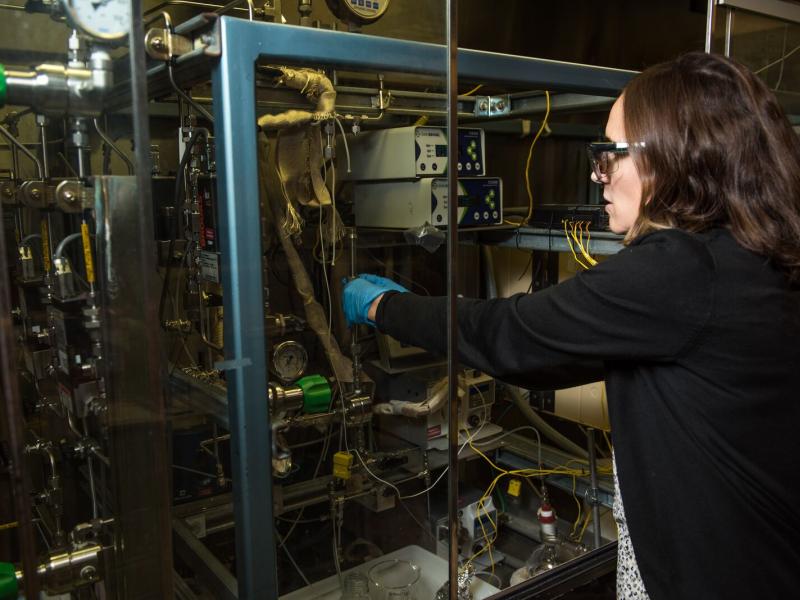
Innovative technology combines continuous, remote, real-time testing and monitoring of byproduct gasses, paving the way for faster advanced reactor development and testing.
As he prepares to enter PNNL's Energy Sciences Center later this year, Vijayakumar 'Vijay' Murugesan is among DOE leaders exploring solutions to design and build transformative materials for batteries of the future.
(ISC)², the world’s largest nonprofit association of cybersecurity professionals, elected PNNL cybersecurity expert Lori Ross O’Neil as vice chairperson of the board of directors.
New 140,000-square-foot facility will advance fundamental chemistry and materials science for higher-performing, cost-effective catalysts and batteries, and other energy efficiency technologies.
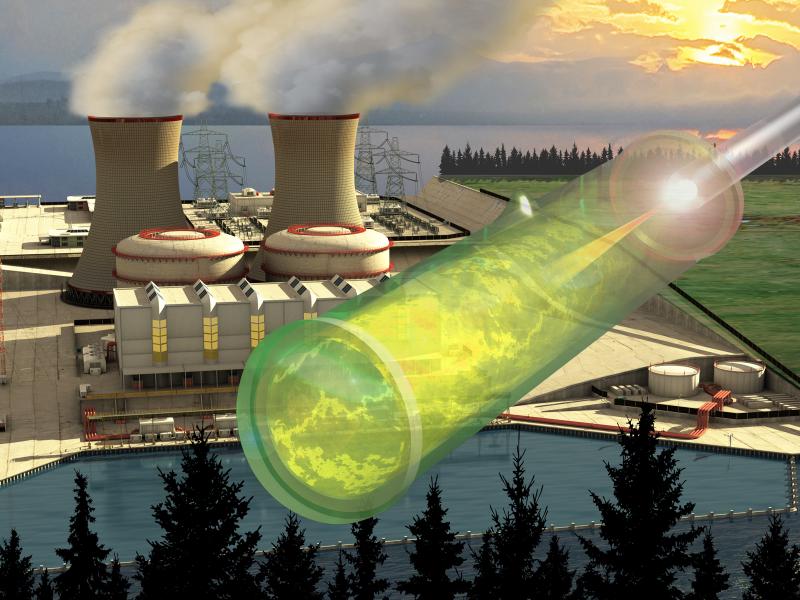
PNNL radiochemist and research manager Patricia Paviet named National Technical Director for the Molten Salt Reactor (MSR) Program by the U.S. Department of Energy’s Office of Nuclear Energy.
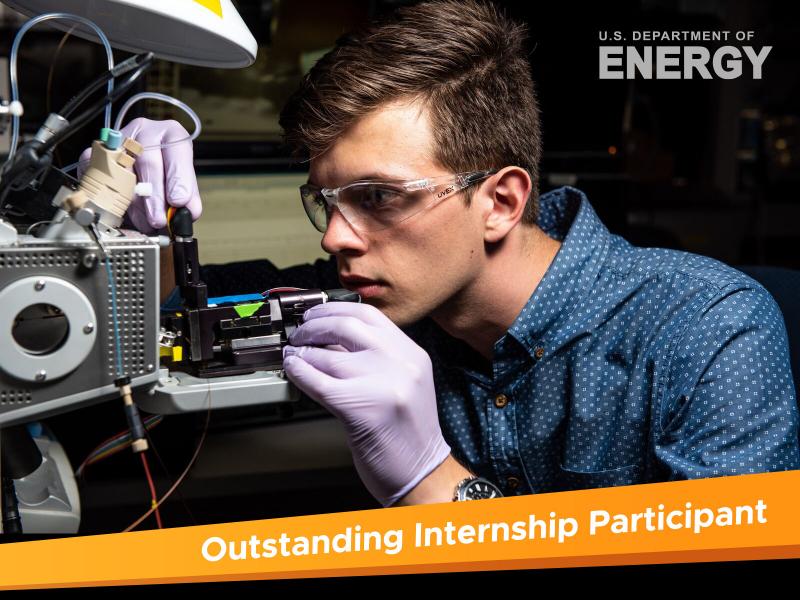
Former PNNL intern Michael Hewitt was recognized by DOE as an Outstanding Intern for the research he performed alongside PNNL physical chemist Dr. Grant Johnson.
PNNL formulated a new type of dual-ion cell chemistry that uses a zinc anode and a natural graphite cathode in an aqueous—or “water-in-bisalt”—electrolyte.
New mathematical tools developed at PNNL hold promise to transform the way we operate and defend complex cyber-physical systems, such as the power grid.
Ann Lesperance, national security advisor, joins the National Academies of Sciences, Engineering, and Medicine Committee on Applied Research Topics for Hazard Mitigation and Resilience.