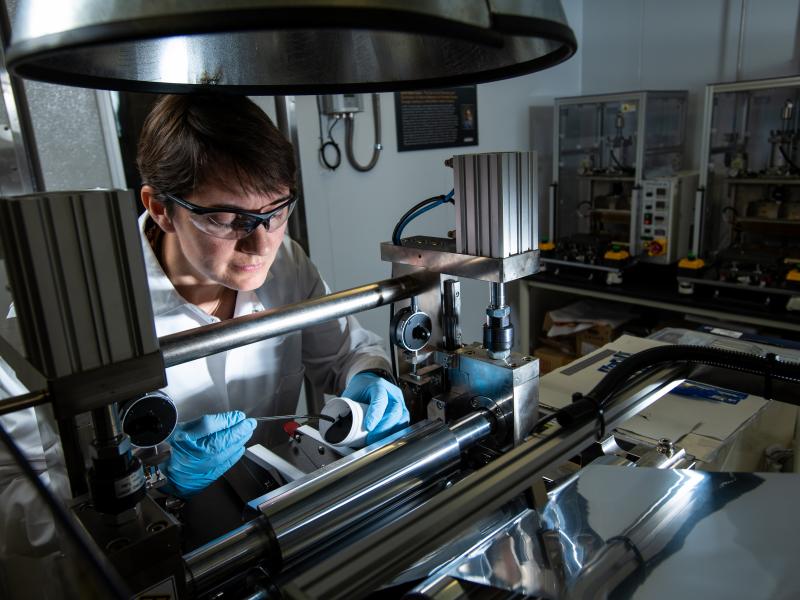
A Helios Hydra UX DualBeam, which utilizes a plasma focused ion beam and scanning electron microscope for sample preparation and analysis, was installed at the Grid Storage Launchpad.
The Sodium-ion Alliance for Grid Energy Storage, led by PNNL, is focused on demonstrating high-performance, low-cost, safe sodium-ion batteries tested for real-world grid applications.
PNNL researchers have developed a new, physics-informed machine learning model that accurately predicts how heat accumulates and dissipates during friction stir processing.
Three PNNL-supported projects are at the forefront of developing advanced data analytics technologies to enhance the U.S. power grid’s reliability, resilience, and affordability.
This work shows that linear pattern scaling is an effective means of obtaining global-to-local relationships for CMIP6 models, as it has been in past model eras.
In a recent publication in Nature Communications, a team of researchers presents a mathematical theory to address the challenge of barren plateaus in quantum machine learning.
Cloud and its radiative effect are among the determining processes for the energy balance of the global climate; they are also the most challenging processes for the climate models to simulate.
The Grid Storage Launchpad dedication event was attended by leaders in grid and transportation energy storage, battery innovation, and industry stakeholders working to transform America’s energy system.
At the Joint Statistical Meeting, the largest gathering of statisticians and data scientists in North America, PNNL researchers presented their latest findings and led a workshop on text analysis and natural language processing.
PNNL staff in the Artificial Intelligence and Data Analytics division were recognized by the TSA’s Innovation Task Force (ITF) for their contributions to cloud capabilities, development strategies, and smart management of cloud resources.