Technology Overview
Air travel continues to grow worldwide, and airports face mounting strain as passenger volumes push security checkpoints to their limits. Traditional screening approaches struggle to keep pace, creating bottlenecks and frustrating efforts to balance security with traveler convenience. Therefore, researchers at Pacific Northwest National Laboratory (PNNL), under Department of Homeland Security (DHS) Science and Technology Directorate (S&T) sponsorship, developed the Aviation Security Screening Optimizer for Risk and Throughput (ASSORT). This risk-based model quantifies threats, vulnerabilities, and consequences across different passenger types and screening technologies, enabling smarter trade-offs between efficiency and security. ASSORT provides a data-driven way to evaluate new screening concepts, optimize operations, and ultimately deliver a safer, faster, and more seamless passenger experience.
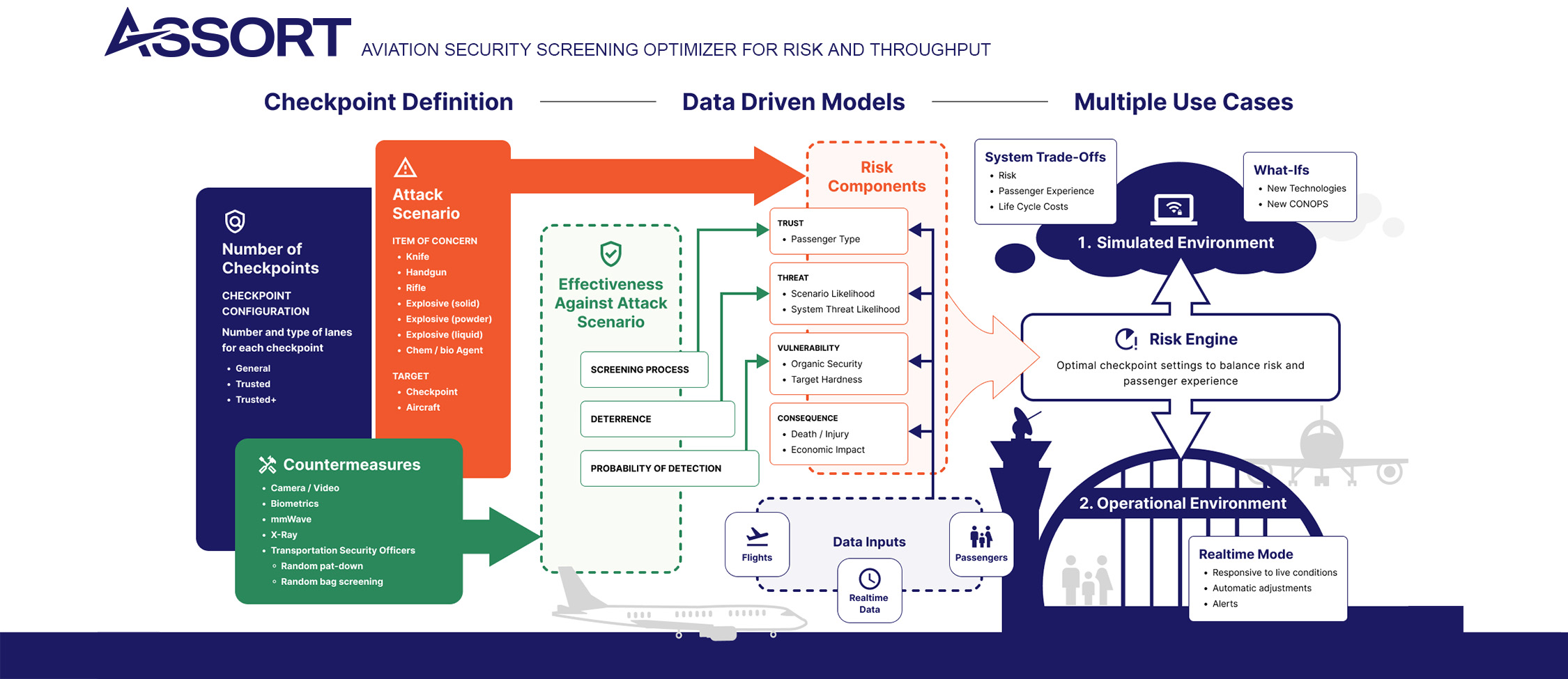
ASSORT builds on earlier risk models developed for the Department of Homeland Security and other government sponsors, extending them to airport checkpoint risk scenarios. By modeling screening technologies such as video surveillance, biometrics, millimeter wave scanning, and X-ray along with procedures including random screening using configurable checkpoint lanes, this tool can test operational scenarios and assess the effectiveness of new technologies.
HOW IT WORKS
ASSORT evaluates how different configurations affect both security effectiveness and operational efficiency by simulating real-world scenarios and generating performance metrics like wait times, throughput, and detection rates. By incorporating risk-based screening logic, it allows planners to test and compare various strategies, helping them make data-driven decisions to balance threat detection with passenger convenience and cost-effectiveness.
By exploring various notional traveler categories (General, Trusted, and Trusted+), along with different checkpoint screening Concept of Operations (CONOPS) tailored to each traveler type, ASSORT can help travelers that arrive to the airport with a higher starting trust level experience fewer screenings, resulting in quicker processing times through the checkpoints.
The output of ASSORT provides a risk score for predefined threat scenarios, as well as the overall risk to the checkpoints, aircraft, and airport by traveler type. ASSORT also produces estimated wait times and throughput by checkpoint and traveler type for each simulated scenario, enabling tradeoff analysis between risk buydown and passenger experience.

APPLICABILITY
By commercializing ASSORT, PNNL and DHS S&T offer a strategic planning and optimization tool that reduces trial-and-error costs, supports compliance with evolving security standards, and enables smarter, more agile airport operations. With increasing global demand for streamlined yet secure passenger screening, ASSORT is not just a tool—it’s a competitive edge in modern aviation security management.
Because ASSORT can function as an analytical tool for both long-term planning and technology evaluation, it is broadly applicable to improving security and efficiency across the aviation sector.
Airports and aviation authorities can use it to optimize checkpoint layouts, staffing, and technology investments, while policy and regulatory agencies can assess new screening strategies and their impact on risk reduction. Technology developers benefit from testing how emerging solutions perform under realistic conditions, and researchers gain a flexible platform for simulating passenger flows, evaluating threat scenarios, and studying the effects of policy changes. Whether applied as a long-term planning tool or a real-time decision aid, ASSORT offers valuable insights to improve security, efficiency, and the passenger experience.
DESIGN
ASSORT is built as a flexible, web-based modeling and optimization platform that combines risk analysis, passenger flow simulation, and operational optimization into a single tool. At its core, the system uses mathematical formulations to model checkpoint operations, allowing users to customize inputs, such as traveler categories, checkpoint layouts, detector thresholds, staffing levels, and random screening rates.
By simulating passenger arrivals across a full day and modeling how different checkpoint configurations affect both risk reduction and throughput, ASSORT gives decision-makers a data-driven way to identify the most effective mix of resources, technologies, and processes.
Advantages
- Assesses risk from a wide range of checkpoint and in-flight threat scenarios.
- Evaluates new technologies and screening concepts to understand their impact on risk reduction and throughput.
- Optimizes checkpoint operations by tailoring screening strategies for different traveler categories (General, Trusted, Trusted+).
- Test and refines staffing, lane configurations, and random screen rates to reduce costs while maintaining security.
- Simulates passenger arrivals and flows across an entire day to plan for real-time decision aid for adaptive checkpoint operations.
- Evaluates “what-if” scenarios to prepare for emerging threats or changing travel demand.
- Improves the passenger experience by reducing wait times and tailoring screening to traveler trust levels.
- Provides flexibility to support both long-term planning and real-time decision-making.
For more information, please contact: commercialization@pnnl.gov