Perspective Paper Showcases How PNNL’s Electrochemical Energy Storage Research Is Shaping the Future of the Electric Grid
The world turns to PNNL for insights into grid-scale electrochemical energy storage
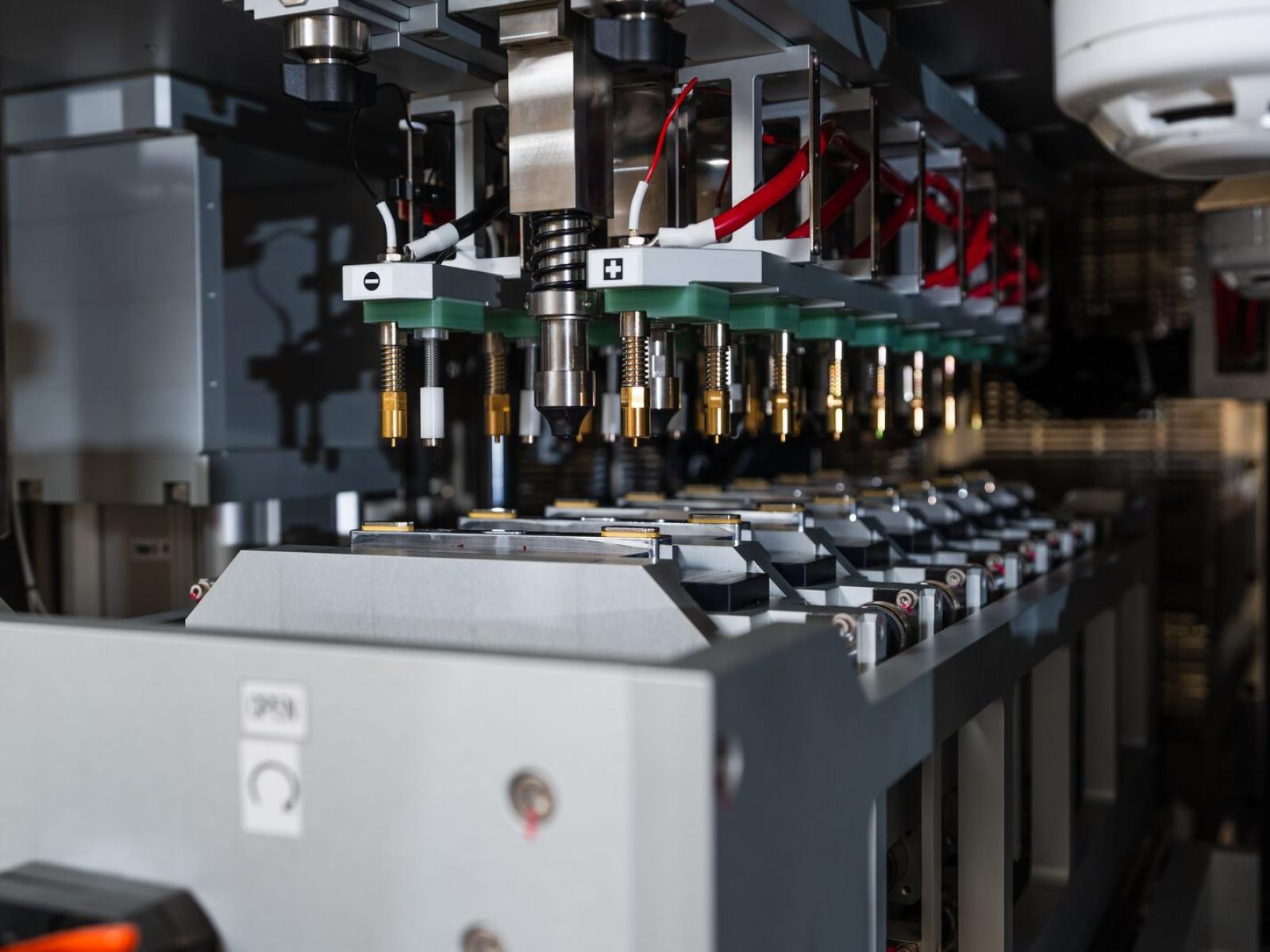
The new prismatic cell line at the Grid Storage Launchpad is one example of how researchers are using the facilities at Pacific Northwest National Laboratory to shape the future of grid energy storage.
(Photo by Eddie Pablo | Pacific Northwest National Laboratory)
Researchers at Pacific Northwest National Laboratory (PNNL) authored an invited perspective paper that was published in Batteries & Supercaps in March 2026. The paper showcases the Lab’s ongoing research into electrochemical energy storage and what it means for the future, as we enter an era of unprecedented energy demand.
Under the direction of the Department of Energy (DOE) Office of Electricity, PNNL researchers have made valuable advancements, from technology and material development to validation testing and assessment of the scalability, affordability, and longevity of some of the most promising electrochemical energy storage technologies. These advancements play a starring role in the published perspective because of their implications for what work still needs to be completed and which paths are most likely to lead us there.
Validating battery storage technologies in the real world
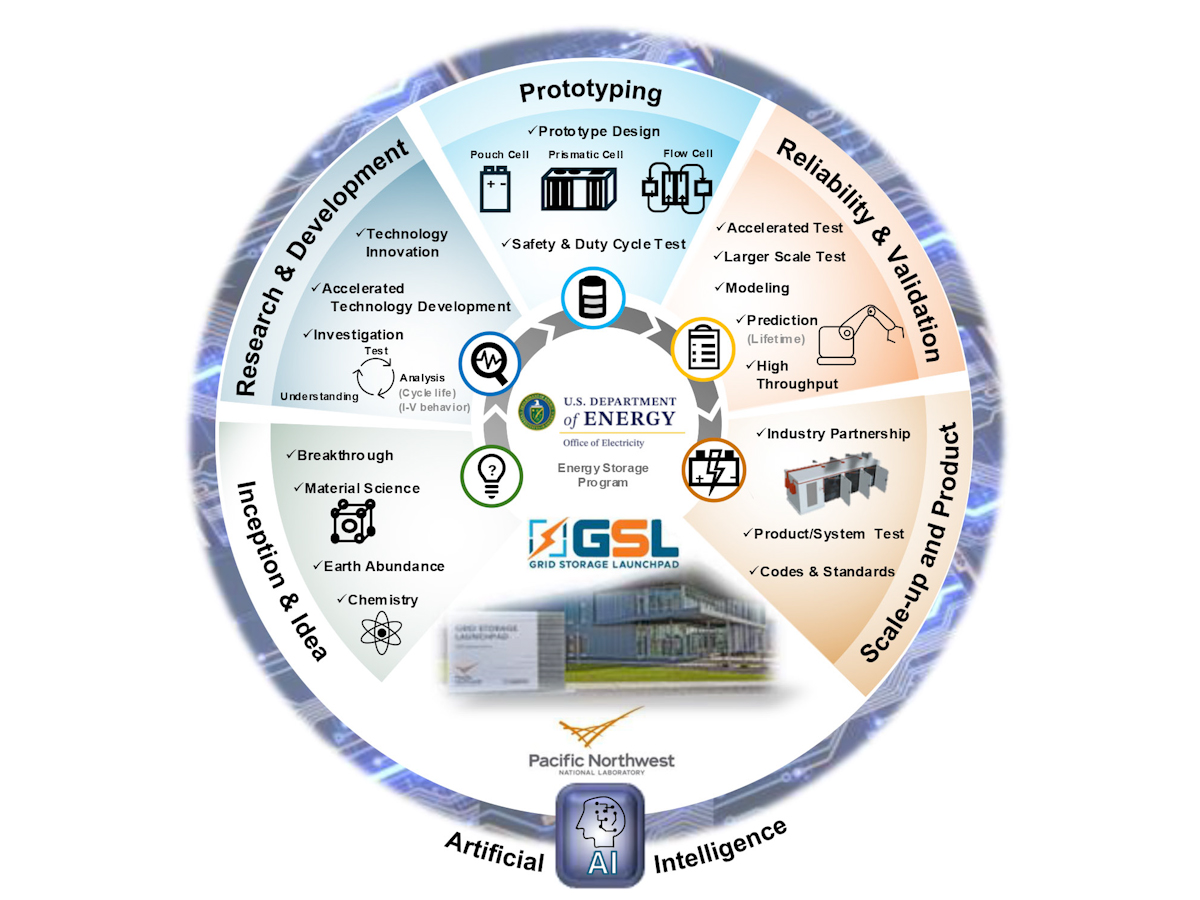
In addition to serving as a leader in the development of new battery energy storage systems (BESSs), PNNL has made strides in validating the performance of these systems under real operating conditions, as opposed to carefully controlled laboratory environments. This accomplishment is possible thanks to the Grid Storage Launchpad (GSL), a core DOE capability housed at PNNL, which allows industry partners, national labs, and academia to test new grid-scale battery storage technologies to accelerate their deployment.
In the GSL, researchers perform validation experiments, known as grid-duty-cycle testing, to simulate scenarios such as grid frequency regulation (i.e., increasing or reducing electricity supply in response to real-time demands over time frames ranging from seconds to minutes) and peak shaving (i.e., storing excess energy during times of low electricity prices or demand and distributing stored energy when electricity prices are high or supplies are low).
Compared with small-scale energy storage technologies such as electric vehicles, grid-scale storage facilities have a much larger physical footprint and different construction, wasting, and recycling processes. Because little is known about how technologies will function at the grid scale, thorough technoeconomic analysis and testing under practical or mimicked grid operation conditions are critical.
Identifying the best candidate technologies for the long term
While lithium-ion BESSs currently dominate the market because of their availability, they may face barriers in terms of safety and domestic supply chains required to meet future U.S. energy needs. PNNL has evaluated some cost-competitive and sustainable alternative BESSs, identifying problems and options that hold the greatest promise, along with their respective footprints. The focus includes redox flow batteries, sodium-ion batteries, lead-acid batteries, and aqueous zinc-based batteries.
Reducing the gap between technology development and deployment
The grid requires BESSs with long life cycles, but the urgency of this need leaves little time for the required testing of their long-term performance. PNNL is helping to solve this problem through the DOE Office of Electricity’s Rapid Operational Validation Initiative, which focuses on accelerating this testing process through the use of AI and machine learning, thereby narrowing the gap between laboratory development and commercial deployment of a technology.
Informing industry standards to keep the grid safe and reliable
The published perspective paper also highlights the prominent role that the PNNL energy storage team plays in helping to develop and update industry codes and standards for energy storage systems, such as those developed by IEEE and the National Fire Protection Association. These standards are critical for guaranteeing the safety and reliability of BESSs.
Sharing a new vision of the future electric grid
The demand for electricity has been growing at unprecedented rates and is not slowing down anytime soon. With numerous large data centers and AI facilities planned for the near future, a major concern is how to supply the energy required while ensuring the U.S. electric grid remains resilient and secure and energy remains affordable for all who need it. The candidate BESSs being evaluated at PNNL are designed to make better use of existing electrical infrastructure, providing an affordable and reliable means of supporting rising energy loads in the years to come.
PNNL researchers are sharing the industry demand and shifting the narrative to highlight that energy storage is more than a useful technology—it’s necessary for the stability and resilience of the future electric grid.
Published: July 7, 2026