MixPI: A Path-Integral Software for Large Systems
New software enables the study of nuclear quantum effects in large, condensed phase systems up to 10× faster than traditional methods
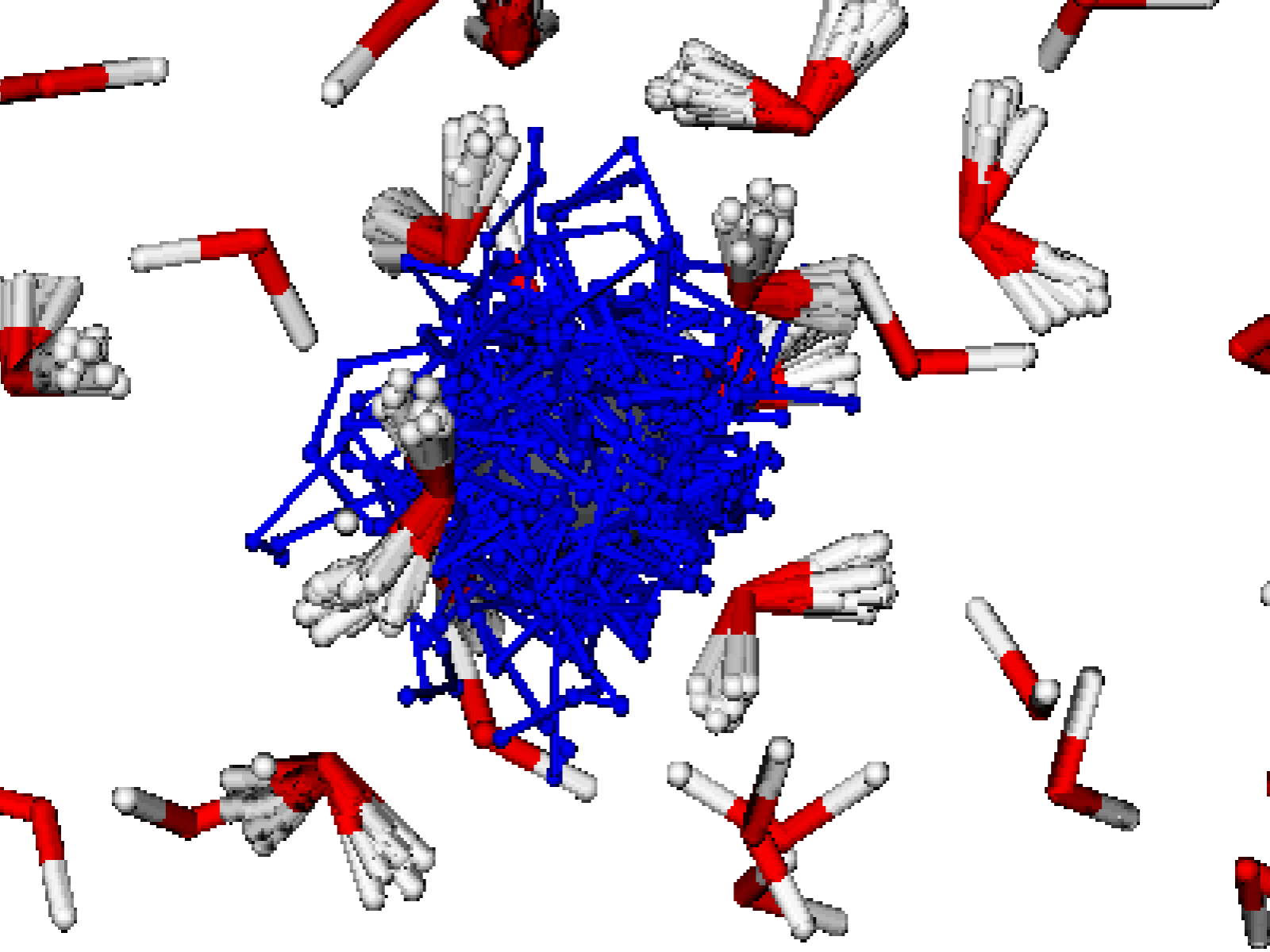
A solvated metal ion M3+ (gray) with an explicit ring polymer electron (blue) solvated by a first solvated shell of ring polymer water (red and white) and remaining waters treated classically. MixPI can use different sized ring polymers to represent different atoms in a simulation, significantly reducing the computational expense of path-integral calculations. The width and size of the ring polymers show the relative strength of the nuclear quantum effects for that atom.
(Image by Britta Johnson | Pacific Northwest National Laboratory)
The Science
Path-integral molecular dynamics is a method for exploring nuclear quantum effects (NQEs) in a wide range of chemical systems. While important for modeling reactions, this approach is limited by its computational cost. A research team developed MixPI, an atomistic path-integral molecular dynamics software that uses an approximation to classically treat most atoms in a system and path-integral calculations for the key atoms that dominate NQEs. MixPI enabled an over tenfold improvement in speed for simulating a solvated metal ion.
The Impact
For many systems in catalysis, biology, and interfacial sciences, NQEs play an important role in calculating accurate structural and dynamic quantities. However, the majority of the NQEs arise from light particles, like hydrogen atoms, or atoms under confinement. Traditional modeling approaches require applying computationally expensive simulations that incorporate NQEs for all atoms. Because MixPI treats only a few select atoms with full path-integral simulations, it is faster and uses fewer computational resources than traditional path-integral molecular dynamics methods. This broadens the type of systems where path-integral-based simulations are computationally practical and is particularly useful for systems previously deemed too large for simulations.
Summary
NQEs play a critical role in accurately simulating a wide array of chemical reactions, including charge transfer reactions, reactions involving hydrogen bonded networks, and reactions under confinement. However, NQEs are computationally expensive to calculate and are often ignored in large simulations. MixPI uses a mixed-time slicing path-integral molecular dynamics approximation. This approximation selects specific degrees of freedom to quantize with a path integral while treating all other atoms in the simulation classically. This treatment enables a substantial reduction in the computational cost for large simulations where only a few atoms contribute to the NQEs.
To evaluate MixPI, researchers looked at two model systems: bulk water and a metal ion (M3+) with an explicit ring polymer electron. In the bulk water simulation, the team treated the hydrogen atoms, which traditionally have larger NQEs, with a large path integral and treated the oxygen atoms as either classical atoms or smaller ring polymers. Using MixPI, they were able to reproduce the radial distribution functions from traditional path-integral molecular dynamics simulations with the mixed-time slicing approach. In the second system, they modeled the solvation environment around an M2+ ion with an M3+ ion with a ring polymer electron. Because the electron is treated as a very large path integral (N=1,000), this system highlights the computational advantage of MixPI for systems in which a small number of atoms contribute to the NQEs.
Contact
Britta Johnson, Pacific Northwest National Laboratory, britta.johnson@pnnl.gov
Greg Schenter, Pacific Northwest National Laboratory, greg.schenter@pnnl.gov
Funding
The authors are grateful to Greg Schenter for useful discussions. B.A.J. and C.J.M acknowledge support from the U.S. Department of Energy (DOE) Office of Science, Basic Energy Sciences program, Division of Chemical Sciences, Geosciences, and Biosciences, Condensed Phase and Interfacial Molecular Science program, FWP 16249. PNNL is operated by Battelle Memorial Institute for the DOE under DOE Contract No. DE-AC05-76RL1830. Research reported in this publication was also partially supported by the National Institute of General Medical Sciences of the National Institutes of Health under award number 1R35GM158400-01 to N.A. S. B. thanks the Cornell Arts and Sciences New Frontiers Grant for seed funding. In addition, N.A. and B.A.J. acknowledge prior support from the DOE, Basic Energy Sciences program, Division of Chemical Sciences, Geosciences, and Biosciences under Award DE-FG02-12ER16362 (Nanoporous Materials Genome: Methods and Software to Optimize Gas Storage, Separations, and Catalysis). This research used resources of the National Energy Research Scientific Computing Center (NERSC), a DOE user facility, using NERSC award BES-ERCAP0036077.
Published: June 30, 2026
Johnson, B. A., S. Bu, C. J. Mundy, N. Ananth. 2026. “MixPI: Mixed-time slicing path integral software for quantized molecular dynamics simulations,” J. Chem. Phys. 164 (21), 212501. DOI: 10.1063/5.0327460.