Orchestrated Platform for Autonomous Laboratories (OPAL)
The Orchestrated Platform for Autonomous Laboratories (OPAL) is a multi-laboratory project led by the Department of Energy (DOE) to turn biological discovery into a self-driving process.
By combining AI, robotics, and automated experimentation, OPAL seeks to create a network of autonomous laboratories that can learn, adapt, and accelerate breakthroughs across biology, biotechnology, and energy sciences.
Through OPAL, a multi-disciplinary research team is building an entirely new research ecosystem for the biological sciences.
The goal: harnessing microbial functions for bio-based manufacturing.
At Pacific Northwest National Laboratory (PNNL), our scientists are using AI to predict and control microbial growth.
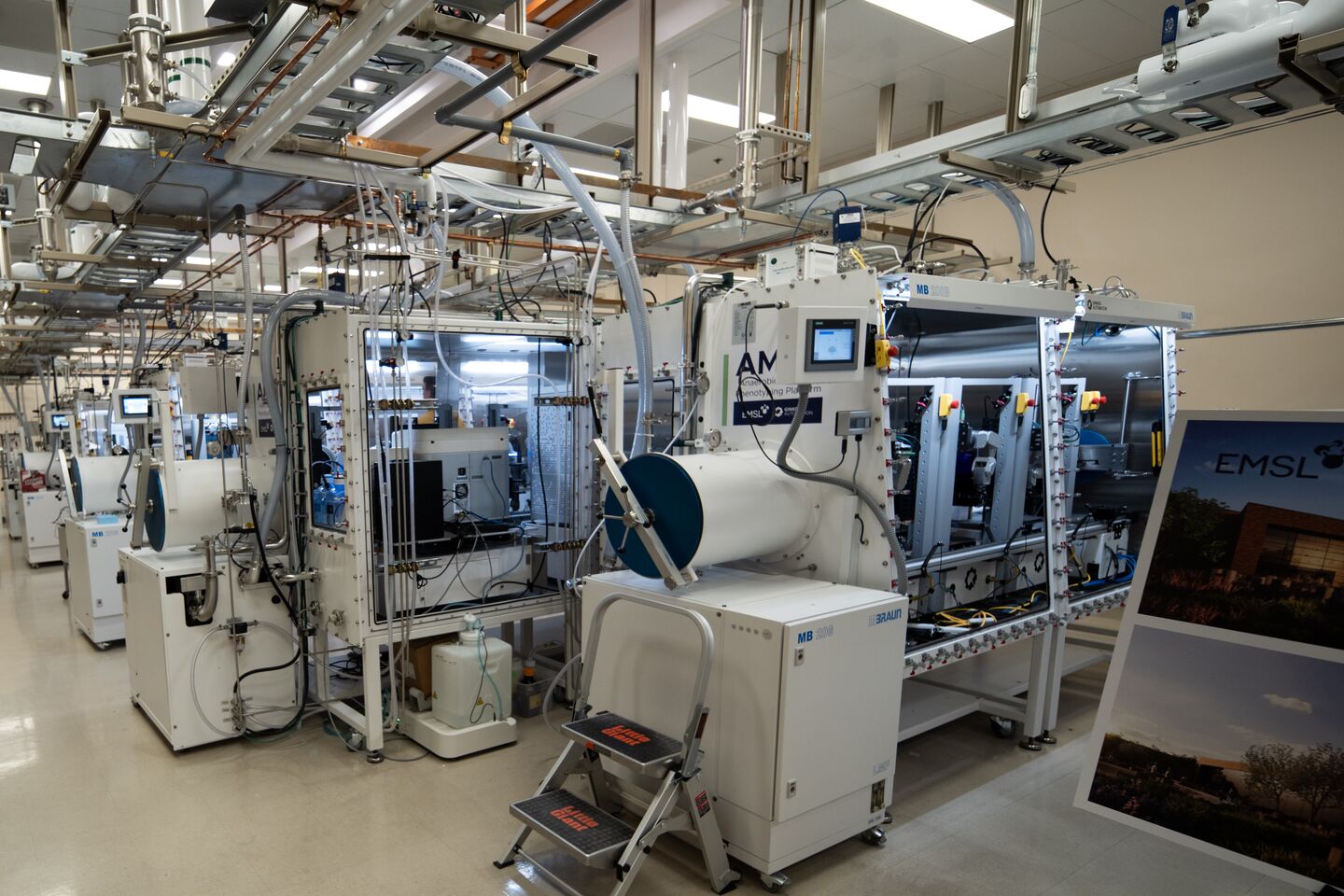
Leveraging the Anaerobic Microbial Phenotyping Platform (AMP2), a fully automated laboratory at the Environmental Molecular Sciences Laboratory, a DOE Office of Science National User Facility located at PNNL, the team evaluates how AI-driven agentic workflows, integrated with multi-modal data (omics, imaging, and physiology), can enable scalable and predictive microbial bioprocess design.
OPAL researchers will draw upon their microbial engineering and AI algorithm development expertise as they develop a distributed platform that will inform the work of all four OPAL partners: Argonne, Oak Ridge, Lawrence Berkeley, and Pacific Northwest National Laboratories.
From recovering critical minerals to scaling up production of useful chemicals for industry, OPAL is poised to transform industrial processes through accelerated biotechnology advances.
PNNL’s OPAL FAMOUS project connects AI models with automated experimentation. When complete, the project’s AI agents and models will serve as the "nerve center" for the OPAL platform, ingesting raw data and translating it into terms that an AI agent can understand, process, analyze, and then act upon.
Ultimately, the multi-disciplinary OPAL research team is working toward an entirely new research ecosystem for the biological sciences.