LEADS introduces a paradigm shift by integrating SciML directly into domain-specific challenges. Working closely with domain scientists, the LEADS team will structure their SciML approach to domain science problems in various complexity levels and assign the proper SciML capability. LEADS is uniquely positioned to address phenomena where traditional numerical methods may be insufficient and expand DOE’s capability in using machine learning for domain science.
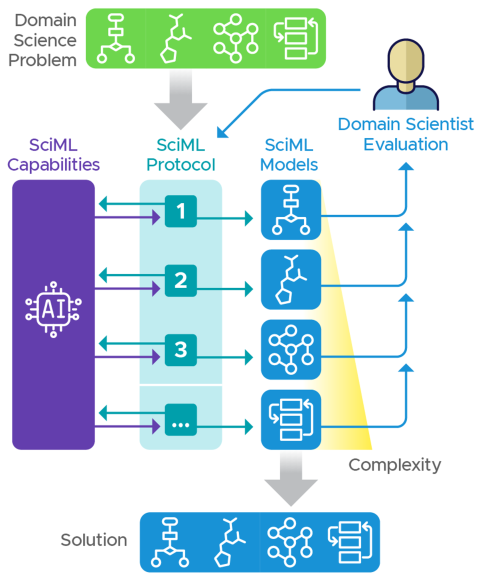
The activities of LEADS are built around three central pillars:
- to develop innovative SciML techniques for complex physical phenomena,
- to deliver scalable SciML software optimized for DOE’s computational infrastructure,
- to provide customized SciML solutions addressing high-priority domain science problems identified in collaboration with DOE stakeholders.
Under these guiding pillars, the research of LEADS is divided into three thrust areas under an overarching theme of foundation models and energy efficiency: functional analytic and probabilistic algorithms, geometric algorithms, and performance optimization.
While the mathematicians leading the research thrusts focus on innovation, the research software engineers of LEADS will concentrate on scalability of their algorithms. They will develop scalable solutions for domain science problems, emphasizing scientist-centric interfaces, seamless integration with DOE computational platforms, and rigorous validation against domain-specific benchmarks. Their work under the LEADS AI Software Center will provide standards, common testing frameworks, and unified community policies.
Through our SciDAC partnerships, the LEADS team will provide customized SciML solutions to domain science problems across multiple fields. LEADS will actively engage with existing SciDAC-5 partnerships, leveraging established collaborations to ensure integration of SciML tools into ongoing DOE research efforts. Beyond SciDAC, LEADS will establish formal collaborations with domain scientists across energy and materials research, providing co-design opportunities to align methods and tools with real-world applications. These partnerships will be formalized through regular workshops, shared data repositories, and joint publications to foster collaborative innovation.