Joint Actinide Shock Physics Experimental Research
Advancing actinide science for national security

Photo by Andrea Starr | Pacific Northwest National Laboratory
The Joint Actinide Shock Physics Experimental Research (JASPER) facility at the Nevada National Security Site (NNSS) is used to study the properties of plutonium under extreme pressure. Using a two-stage light gas gun, JASPER launches projectiles at speeds of up to eight kilometers per second (~17,000 miles per hour) to create high-pressure shock states. These experiments provide critical data on material properties, such as the equation of state. This data is an integral part of the National Nuclear Security Administration’s (NNSA) Stockpile Stewardship Program, ensuring the safety, security, and reliability of the U.S. nuclear deterrent.
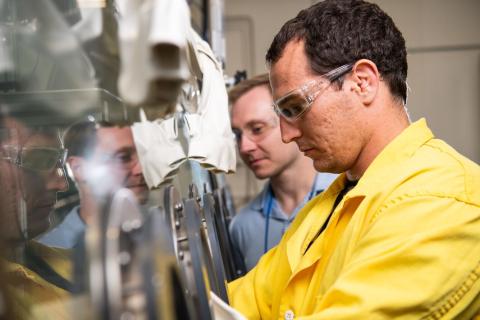
Pacific Northwest National Laboratory (PNNL) is a key partner in the JASPER mission, working in close collaboration with Lawrence Livermore National Laboratory and NNSS teams. At PNNL, efforts are centered at the Radiochemical Processing Laboratory, where researchers leverage expertise in plutonium handling and processing to fabricate and characterize high-precision targets for JASPER experiments. These targets, developed to meet rigorous technical specifications, are shipped to the Device Assembly Facility at NNSS for final assembly and then to JASPER for use in experiments.
This work represents the first of what PNNL anticipates will be many impactful projects supporting NNSA’s broader defense programs. By contributing advanced actinide science and precision fabrication and characterization capabilities, PNNL helps strengthen national security research and ensures the success of mission-critical efforts to sustain the U.S. nuclear stockpile.