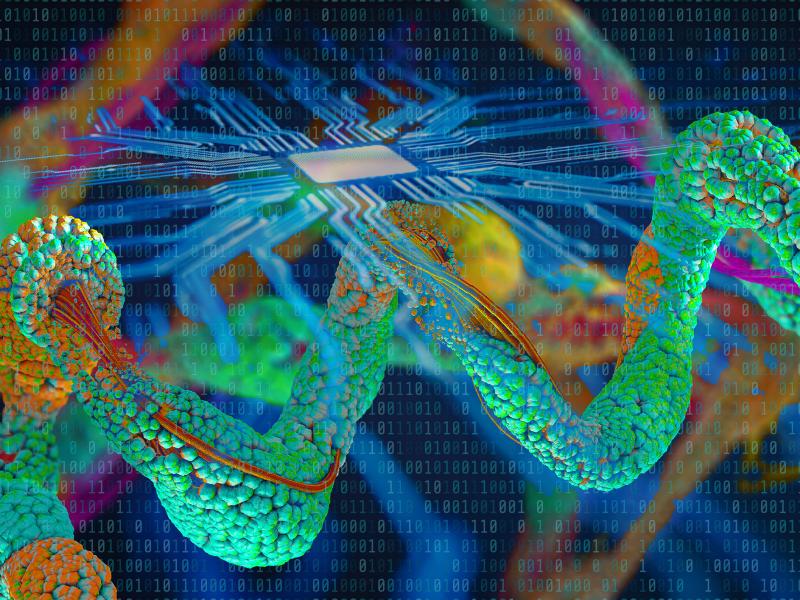
Controlling the nanostructure of silk fibroin—a protein found in silk—is a key step toward designing and fabricating electronics that leverage the material’s promising mechanical, optical and biocompatible properties.
A team of researchers at PNNL is developing a new approach to explore the higher-dimensional shape of cyber systems to identify signatures of adversarial attacks.
Samrat (Sam) Chatterjee, a PNNL chief data scientist and team leader with the Data Sciences and Machine Intelligence group, was co-author of a CSET workshop report on agentic artificial intellilligence
Sergei Kalinin honored with the David Adler Lectureship Award for contributions to materials physics through automated experimentation and ferroelectric materials work.
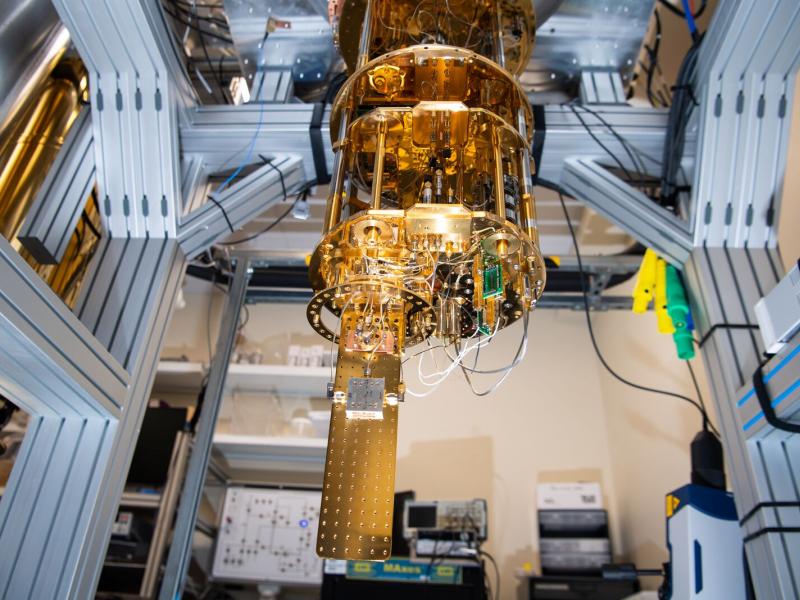
In a recent publication in Nature Communications, a team of researchers presents a mathematical theory to address the challenge of barren plateaus in quantum machine learning.
Ultra-thin layers of silk deposited on graphene in perfect alignment represent a key advance for the control needed in microelectronics and advanced neural network development.