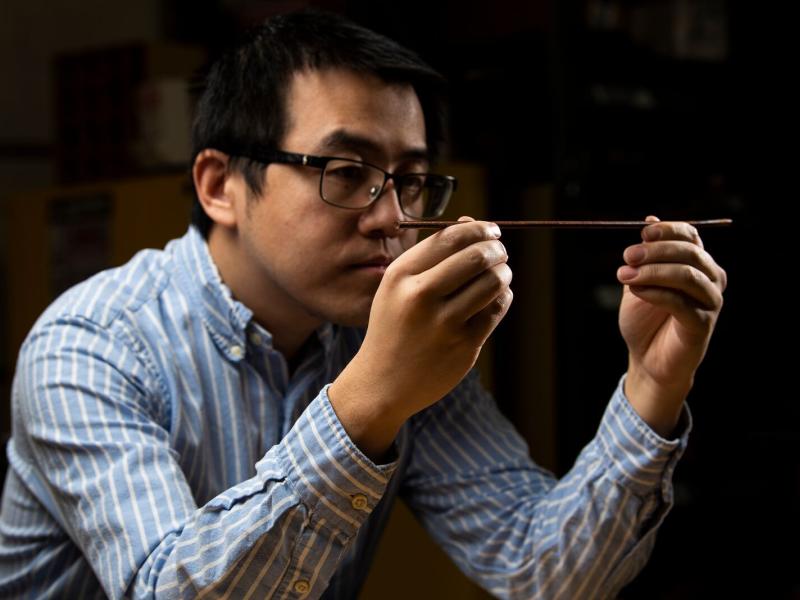
Harilal, a physicist at PNNL and a Jedi in laser-produced plasma applications, has been named a member of the Institute of Electrical and Electronics Engineers Class of 2025 fellows.
For 50 years, the NNSA and its predecessor DOE organizations have stewarded the resources and capabilities to respond to nuclear and radiological emergencies in the United States and around the world.
Led by interns from multiple DOE programs, a newly expanded dataset allows researchers to use easy-to-obtain measurements to determine the elemental composition of a promising carbon storage mineral.
PNNL’s year in review includes highlights ranging from advancing soil science to understanding Earth systems, expanding electricity transmission, detecting fentanyl, and applying artificial intelligence to aid scientific discovery.
A team of researchers recently coordinated a series of international workshops aimed at enhancing chemical research security and fostering collaboration among scientists and academic researchers from both countries.
PNNL and one of the world’s largest tire makers will work to develop a commercially viable process that converts ethanol derived from sustainable sources or waste, like recycled tires, to butadiene, synthetic rubber’s main ingredient.
Sergei Kalinin, a joint appointee at the University of Tennessee, Knoxville and PNNL, and Ji-Guang (Jason) Zhang, a PNNL Lab Fellow, are part of the 2024 class of National Academy of Inventors Fellows.
PNNL Earth scientist Alison Delgado will serve as an author for the “Science of Response Management” chapter of the Sixth National Climate Assessment (NCA6.)
In partnership with the Ukrainian Government, PNNL and other U.S. implementers set out on a journey to create a roadmap to rebuild, modernize, and decarbonize Ukraine’s steel industry with small modular reactors.