Technology Overview
The transition to mildly flammable refrigerants, such as difluoromethane (R32), has introduced new safety challenges for residential and commercial heating, ventilation, and air conditioning (HVAC) systems. Refrigerant leaks can reduce system performance, compromise reliability, and pose health and fire hazards due to flammability and toxicity, as classified by the American Society of Heating, Refrigerating and Air-Conditioning Engineers (ASHRAE). Rapid, reliable, and low-cost leak detection is critical for occupant safety, regulatory compliance, and efficient HVAC operation.
While several refrigerant leak sensors are commercially available, few low-cost options meet the performance, selectivity, and response requirements of current safety standards. Recognizing this gap, stakeholders in the Department of Energy’s Refrigerants R&D Working Group have identified the development of faster, more selective, and cost-effective refrigerant sensors as a critical priority. The Department of Energy’s Building Technologies Office funded research at Pacific Northwest National Laboratory to develop a faster, more selective, and cost-effective refrigerant leak sensor. This project is guided by an external technical advisory committee with representatives from industry, government, and national laboratories.
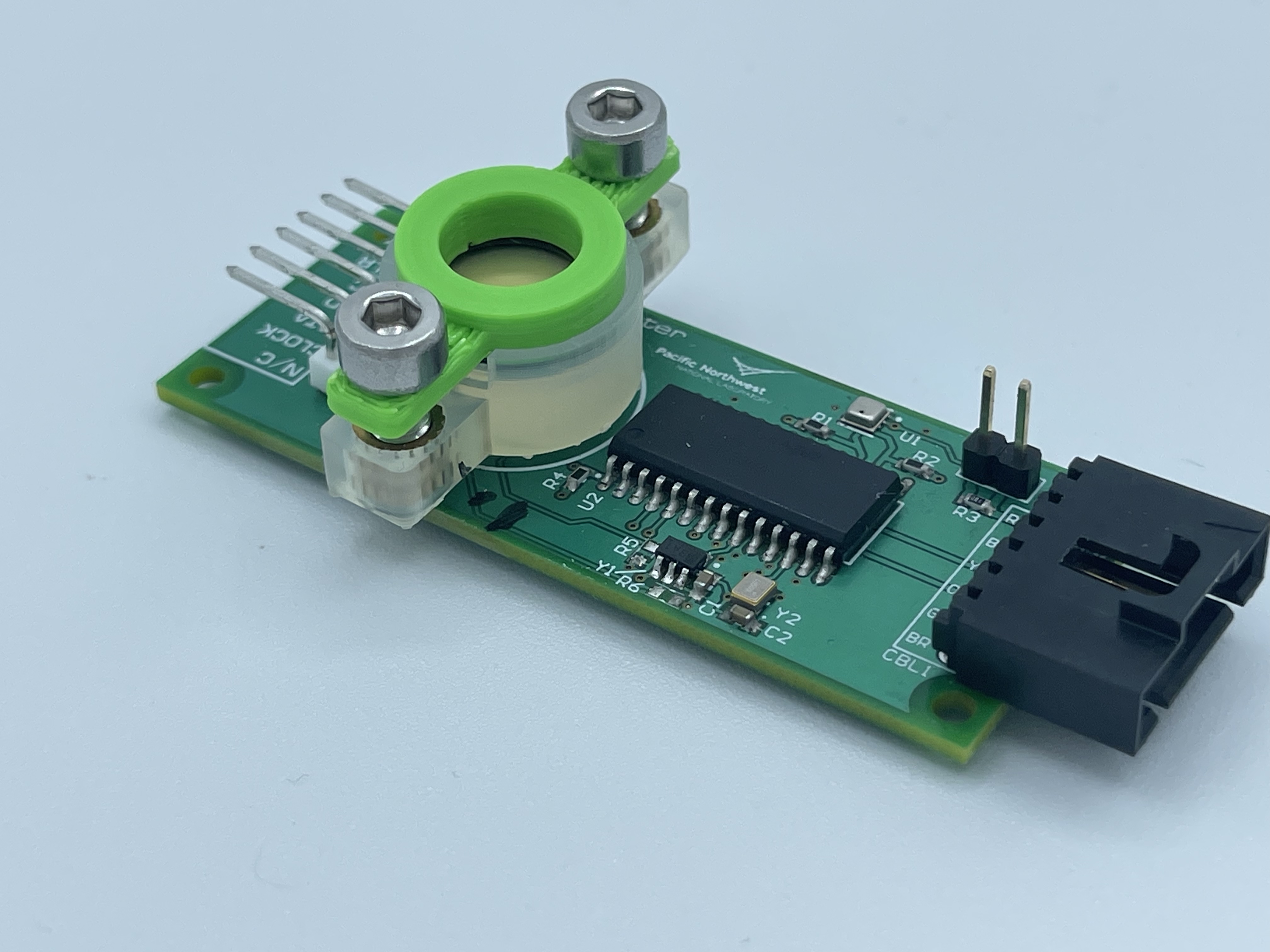
The resulting sensor leverages metal-organic frameworks (MOFs), which are highly porous, crystalline materials, integrated onto a quartz crystal microbalance (QCM). This combination enables rapid, selective, and low-temperature detection of mildly flammable refrigerants, supporting early leak detection, refrigerant emission reduction, and HVAC efficiency.
HOW IT WORKS
The sensor consists of a QCM coated with a hydrophobic MOF that selectively adsorbs certain refrigerants. When refrigerant molecules come into contact with the MOF, they are captured within its porous structure, increasing the effective mass of the QCM. This mass change produces a proportional shift in the crystal’s resonance frequency, which directly correlates with refrigerant concentration. The sensor responds within seconds, maintains stability under high-humidity conditions, and consumes minimal power, enabling fast, reliable, and energy-efficient leak detection. Its rapid response is particularly important for flammable refrigerants, where early detection is essential for safety.
APPLICABILITY
This technology is suitable for real-time leak detection in residential, commercial, and industrial HVAC systems, including heat pumps, air conditioners, and refrigeration units. It is particularly valuable in enclosed or equipment-heavy spaces where early detection is essential for safety and compliance. By providing timely alerts, the sensor helps reduce refrigerant emissions, prevent flammable incidents, and maintain system efficiency.
DESIGN
The sensor was developed through the screening of five candidate MOFs (ZIF-67, HKUST-1, MIL-101, MOF-74, and UiO-66) on the basis of surface area, thermal stability, and water adsorption behavior. The selected MOF exhibits rapid, repeatable adsorption of R32 with minimal signal lag even under high-humidity conditions. Once deposited onto the QCM substrate, the MOF layer captures refrigerant molecules, producing measurable shifts in resonance frequency. The low-temperature operation, humidity tolerance, fast response, and low power requirements make the sensor suitable for distributed deployment in leak-prone locations such as equipment rooms, indoor HVAC units, and refrigeration systems. This design supports early leak detection, safety compliance, reduced refrigerant emissions, and improved HVAC efficiency through timely maintenance.
Advantages
- Fast response time (seconds)
- High selectivity
- Low-temperature operation
- Humidity tolerance
- High sensitivity
- Low power consumption
- Cost-effective and scalable
- Calibratable and stable
- Versatile integration into HVAC and refrigeration systems
State of Development
Patent pending