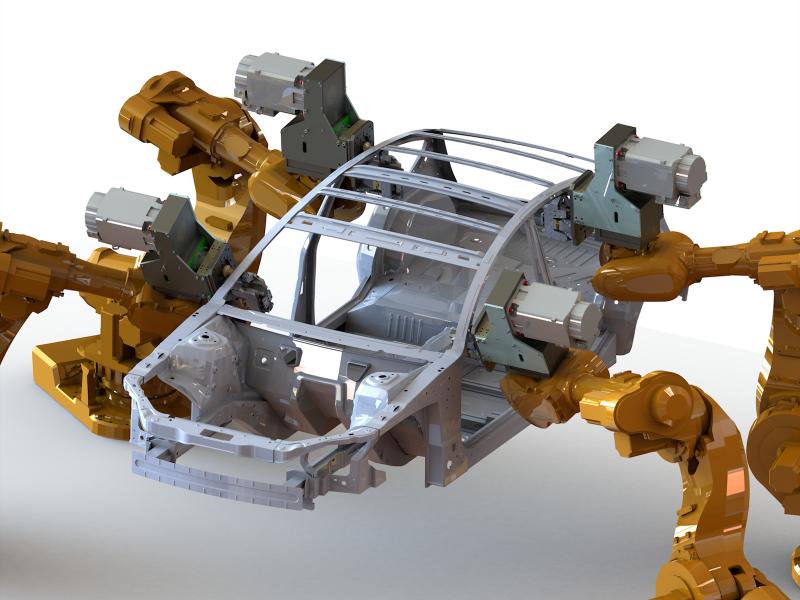
A breakthrough at PNNL could free friction stir from current constraints—and open the door for increased use of the advanced manufacturing technique on commercial assembly lines.
PNNL researchers have published their paper, “Introducing Molecular Hypernetworks for Discovery in Multidimensional Metabolomics Data,” in the Journal of Proteome Research.
By combining computational modeling with experimental research, scientists identified a promising composition that reduces the need for a critical material in an alloy that can withstand extreme environments.
A team of researchers at PNNL is developing a new approach to explore the higher-dimensional shape of cyber systems to identify signatures of adversarial attacks.
PNNL researchers have developed a new, physics-informed machine learning model that accurately predicts how heat accumulates and dissipates during friction stir processing.
Visual Sample Plan, a free software tool developed at PNNL that boosts statistics-based planning, has been recognized with a 2024 Federal Laboratory Consortium Award.