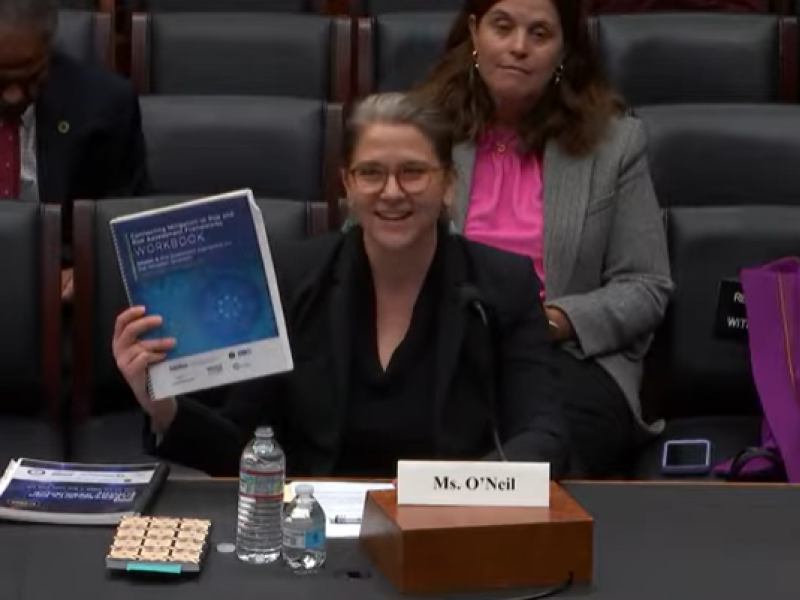
Rebecca O’Neil, a research principal in the Energy and Environment Directorate at PNNL, was invited to testify before the House Committee on Energy and Commerce’s Subcommittee on Energy.
Peter Heine, senior advisor in the Strategic Threat Analysis group at PNNL, recently travelled to Brussels, Belgium, to support the World Customs Organization's Operation Stingray.
A team of researchers at PNNL has received the 2025 National Nuclear Security Administration CIO Award for developing an innovative solution to enhance secure communications.
PNNL's E-COMP initiative is helping unleash American energy innovation with advanced theories, models, and software tools to better operate power systems that rely heavily on high-speed power electronic control.
Three PNNL technologies have been declared winners of 2025 Federal Laboratory Consortium Awards, named for a program that recognizes federal laboratories and their industry partners for outstanding technology transfer achievements.
For PNNL’s Jonathan Evarts, Hope Lackey, and Erik Reinhart, this partnership with WSU opened doors and provided opportunities for their scientific careers to flourish.
The Generator Scorecard, developed by PNNL in partnership with BPA, automates generator evaluations, reducing engineering workloads and improving grid reliability.
The National Transmission Planning Study presents several transmission expansion scenarios that would reliably support the growing demand for energy across the nation.
Staff at PNNL recently traveled to Cyprus to facilitate a multilateral workshop on chemical forensics investigations hosted by the U.S. Department of State, Office of Weapons of Mass Destruction Terrorism.
Staff at PNNL recently visited the University of Texas at San Antonio to deliver lectures on international law, arms control, and nuclear nonproliferation during Nuclear Policy Week.
PNNL staff scientist selected as a guest editor for a special issue titled “Ligand-Metal Complementarity in Rare Earth and Actinide Chemistry,” in the well-known journal Inorganic Chemistry.
PNNL computing experts Robert Rallo and Court Corley contribute their knowledge to a recent DOE report on applications of AI to energy, materials, and the power grid.
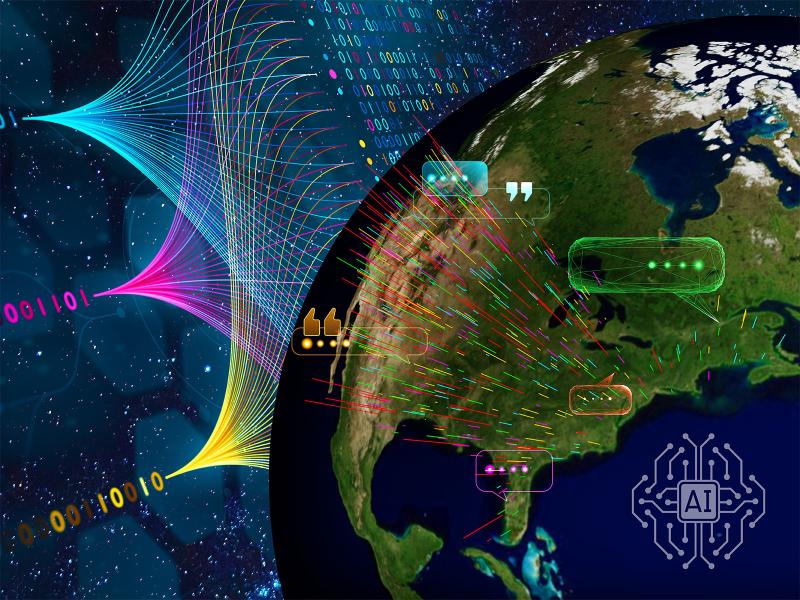
ChatGrid™ is a practical application of the Department of Energy’s exascale computing efforts and offers a new experience in easy, intuitive, and interactive data interaction.
PNNL helps deliver efficiency-related rules and requirements that steadily improve performance of America’s buildings, saving energy and costs and reducing carbon emissions.
Mandy Mahoney, director of the DOE Building Technologies Office, visited PNNL in late November. One key agenda item involved meeting with staff for a discussion of effective equity and justice integration in buildings-related research.